





Key Takeaways
- Most sites see meaningful SEO results within three to six months of consistent effort.
- New domains may experience a sandbox effect — Google can take up to 12 months to assess new sites.
- SEO requires ongoing optimization — it is not a one-time setup.
- Google makes thousands of algorithm changes annually (over 4,000 per year per Google’s own documentation) — rankings are never static.
- Technical SEO issues can delay results significantly.
- Organic search has historically generated over 50% of all site traffic (BrightEdge Research, trend data) — the payoff for sustained SEO investment is substantial.
Introduction
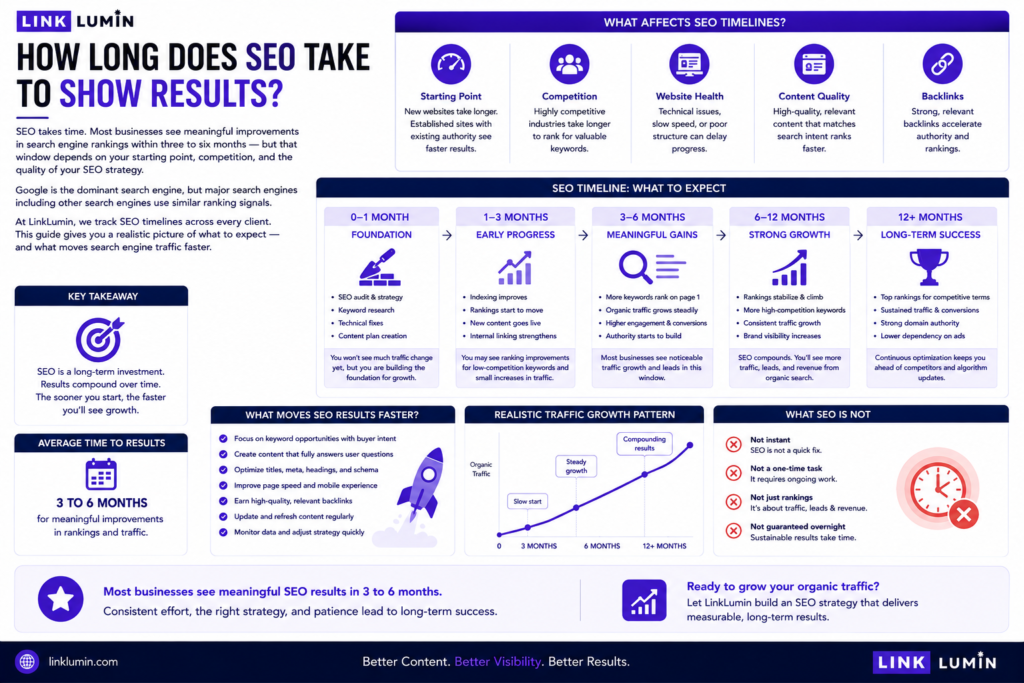
SEO takes time. Most businesses see meaningful improvements in search engine rankings within three to six months — but that window depends on your starting point, competition, and the quality of your SEO strategy. Google is the dominant search engine, but major search engines including other search engines use similar ranking signals. At LinkLumin, we track search engine optimization SEO timelines across every client. This guide gives you a realistic picture of what to expect — and what moves search engine traffic faster.
Who This Guide Is For
This is for business owners and marketers investing in search engine optimization who want to know when results will come.
The Honest Answer: Three to Six Months
Most sites see results within three to six months of consistent SEO effort. That pattern emerges across competitive analysis, industry data, and our own client work.
Three to six months assumes a site that:
- Has no significant technical SEO issues blocking crawlers.
- Is publishing quality content consistently.
- Has at least some existing search rankings to build on.
- Is targeting search intent accurately with relevant keywords.
Remove any of those factors and the timeline extends.
Why New Sites Take Longer
New domains face an additional challenge. Google can take up to 12 months to assess a new site — the sandbox effect.
New sites need to:
- Earn quality backlinks from credible external links.
- Build a content library covering their target keywords.
- Fix technical issues early — broken links, site structure problems, and multiple URLs causing duplication delay progress.
Patience is not optional for new domains.
What Speeds Up SEO Results?
Certain factors consistently accelerate the SEO timeline. Understanding them helps you invest effort where it counts.
Technical SEO: Fix First
Technical SEO ensures web crawlers can access, read, and index your site efficiently. Technical optimization is foundational.
Common issues that delay results:
- Crawl errors blocking web pages from being indexed.
- Slow page speeds reducing user experience.
- Missing or broken internal links preventing search engines from discovering content.
- Multiple URLs creating duplicate content issues.
Run a technical audit first. Technical issues delay rankings even when your content and off-page SEO are strong.
On-Page SEO: Align With Search Intent
On-page SEO aligns your content with what users are actually searching for. It covers keyword research, content relevance, page optimization, and HTML elements.
Google prioritizes valuable content that fully addresses searcher needs. Your target audience expects relevant answers — not keyword-stuffed filler.
Applying on-page SEO techniques:
- Map target keywords to user intent using Google Keyword Planner and SEO tools.
- Use structured data and rich snippets to improve appearance in search results pages.
- Optimize for featured snippets on informational queries.
- Apply content optimization across all key pages — not just new posts.
- Consider answer engine optimization and generative engine optimization as part of broader SEO efforts.
Off-Page SEO: Build Authority Over Time
Off-page SEO builds credibility through what other websites say about you. Backlinks are a key ranking factor, and backlink quality matters more than quantity.
Effective off-page strategies:
- Earning coverage in industry publications.
- Building local SEO citations and consistent business information.
- Generating user-generated content such as reviews.
- Publishing original research that earns links from other websites.
The Role of Competition in Your Timeline
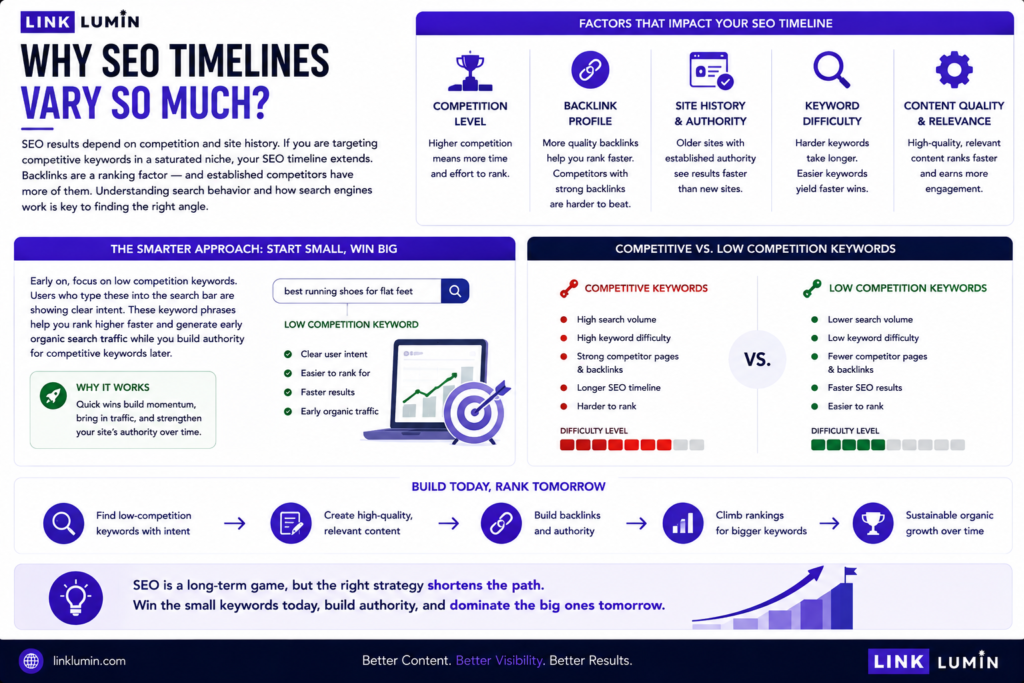
SEO results depend on competition and site history. If you are targeting competitive keywords in a saturated niche, your SEO timeline extends. Backlinks are a ranking factor — and established competitors have more of them. Understanding search behavior and how search engines work is key to finding the right angle.
The smarter approach early on is to target low competition keywords. Users who type these into the search bar are showing clear intent. These keyword phrases help you rank higher faster and generate early organic search traffic while you build authority for competitive keywords later.
Algorithm Changes and Ranking Volatility
Google makes thousands of algorithm changes annually — over 4,000 per year by its own documentation. Rankings are not static. A page that ranks well today may shift after an update.
SEO requires ongoing optimization. Content updates should follow a three-to-six-month rhythm. SEO audits should occur at least once a year.
Tracking performance is non-negotiable. Use Google Analytics and Google Search Console to monitor:
- Organic search traffic trends and search visibility over time.
- Keyword ranking changes after algorithm updates.
- Search queries and search behavior patterns.
- Technical issues flagged in Search Console.
Search analytics reveal whether you need to publish relevant, fresh content to maintain positions.
Local SEO Has Its Own Timeline
Local SEO for geographically targeted search rankings often moves faster than national campaigns. The competitive field is smaller and search intent is specific. Local SEO tactics include keeping business information consistent and collecting positive reviews — both show results in weeks, not months.
Fastest local wins:
- Claiming and completing a Google Business Profile.
- Building local citations with consistent NAP (Name, Address, Phone).
- Generating genuine customer reviews.
- Targeting location-specific keyword phrases in on-page SEO.
What Does SEO Success Look Like Over Time?
Understanding the SEO timeline helps set realistic expectations for different phases.
| Phase | Timeframe | What to expect |
|---|---|---|
| Foundation | Months 1–2 | Technical fixes, content audits, on-page optimization. Minimal ranking movement. |
| Early traction | Months 3–4 | Organic traffic grows on low-competition keywords. Impressions rising in Search Console. |
| Measurable growth | Months 4–6 | Keyword rankings improving. Backlinks being earned. Analytics shows positive engagement. |
| Authority building | Months 6–12 | Competitive keywords moving. Featured snippets appear. Organic search drives business value. |
| Compounding | Year 2+ | Sustained organic traffic without per-click costs. Topical authority established. |
When to Bring In an SEO Specialist
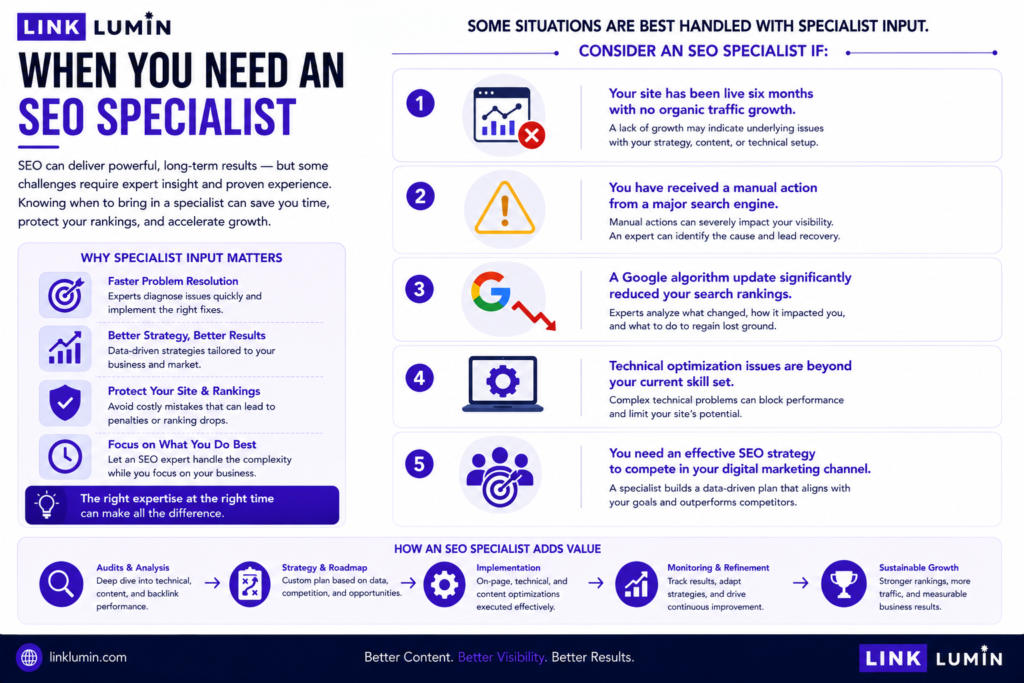
Some situations are best handled with specialist input. Consider an SEO specialist if:
- Your site has been live six months with no organic traffic growth.
- You have received a manual action from a major search engine.
- A Google algorithm update significantly reduced your search rankings.
- Technical optimization issues are beyond your current skill set.
- You need an effective SEO strategy to compete in your digital marketing channel.
Paid search accounts for 15% of all site traffic (BrightEdge Research). Organic search generates 53% — the long-term value of SEO is clear.
FAQs
1. How long does SEO take for a new website?
New websites typically take six to twelve months to show meaningful results in search engine rankings. Google may take up to 12 months to fully assess a new domain — the sandbox effect. During this period, focus on technical SEO, content creation, and building quality backlinks. Targeting low-competition keywords early generates organic search traffic while authority builds gradually over time.
2. What factors most affect how long SEO takes?
The biggest factors are site age, competition level, content quality, technical health, and consistency. Search engines evaluate on-page SEO, off-page SEO, and domain authority together. Established sites see results faster than new domains. Technical SEO issues delay ranking improvements even when content is strong — audit and fix those first before scaling content output.
3. Can I speed up SEO results with better strategy?
Yes — within limits. A focused SEO strategy that targets low competition keywords, fixes technical issues early, and publishes quality content consistently delivers search results faster than a scattered approach. You cannot force Google to rank you faster, but you can remove obstacles. Use Google Analytics and Google Search Console to track organic search performance and adjust quickly based on what the data shows.
4. Is local SEO faster than national SEO for search rankings?
Generally yes. Local SEO operates in a smaller competitive field with more specific search intent. Local businesses targeting location-based search queries and featured snippets can see visible ranking improvements within weeks of optimising their Google Business Profile, building local citations, and collecting reviews. National or global campaigns targeting broad, competitive keywords take much longer — often twelve months or more to show significant organic search traffic growth.
5. How do I know if my SEO is actually working?
Track organic search traffic in Google Analytics and monitor keyword positions in Google Search Console. Look for growing impressions and more pages appearing in search results over time. On-page SEO and technical optimization improvements should show up within weeks; off-page SEO gains take longer. Watch for featured snippets on target queries — winning one signals strong topical authority. Ultimately, measure conversions from organic search, not just rankings.