





Global SEO is the practice of optimizing a website to rank in search results across multiple countries and languages simultaneously. Most Ontario businesses do not need it — they need local or regional SEO instead. Link Lumin’s SEO services help businesses in Brampton and across Ontario choose the right scope and build a strategy that matches their actual customer geography.
For Ontario business owners, marketing managers, and anyone who has been told they need “international SEO” and wants to know whether that is actually true for their situation.
Key Takeaways
Global SEO targets international or multi-regional audiences searching in different languages across multiple countries — a fundamentally different scope from local or national Canadian SEO.
Global SEO is necessary only when a business has paying customers in multiple countries who search in different languages — a profile that applies to a small fraction of Ontario service businesses, mostly in SaaS, e-commerce, and professional services with international clients.
Hreflang tags, country code top-level domains (ccTLDs), and separate URL structures are the three technical pillars of global SEO.
Each one adds significant implementation cost and ongoing complexity.
That cost is only justified when the business has demonstrated revenue from multiple international markets — not aspirational expansion goals.
Local SEO targets nearby consumers looking for a physical storefront or local service provider. It relies on an optimized Google Business Profile, local citations, and geo-specific content — not international infrastructure.
The cost gap between local SEO (C$800–C$3,000/month) and a properly implemented global SEO strategy (C$5,000–C$20,000+/month) reflects genuinely different scope, not markup.
For any Ontario business that has been told it needs global SEO, the first question to ask is: in which countries do we have actual paying customers who search in a language other than English?
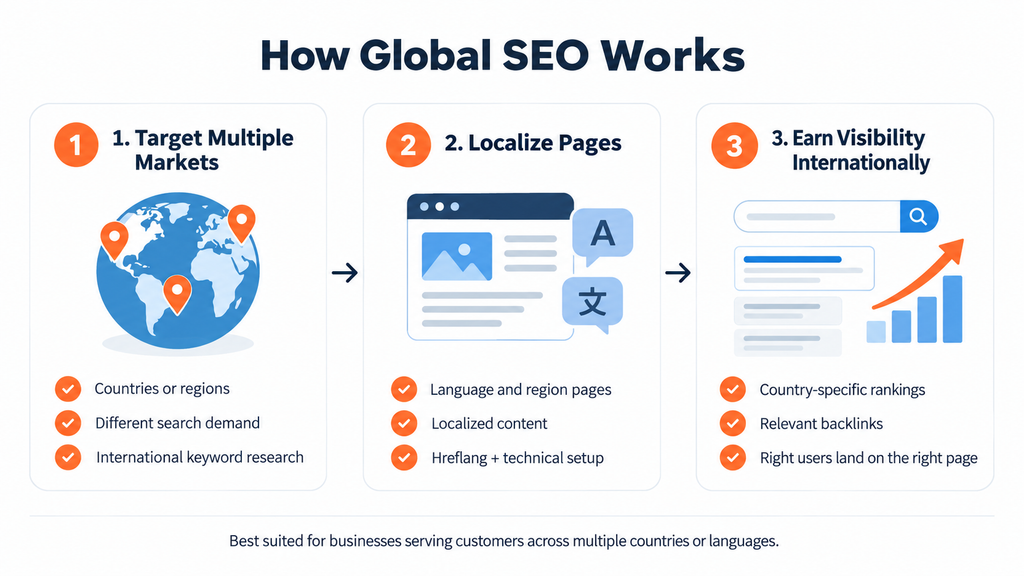
Global SEO, Defined
Global SEO is a search engine optimization strategy that enables a website to rank across multiple countries and languages by implementing country- or language-specific technical infrastructure, localized content, and market-specific link-building.
It differs from standard SEO in that a single strategy is insufficient — each target country or language market requires its own keyword research conducted separately, its own localized content, and often its own URL structure.
Global SEO is the right choice when a business genuinely serves customers in multiple countries who search in different languages and expects meaningful revenue from each market.
How It Works
Global SEO works by signalling to search engines which version of your content is intended for which audience — by language, by country, or by both.
Each version must be discoverable, crawlable, and ranked independently in its target market. Without this infrastructure, search engines interpret your content as a single undifferentiated resource and serve it inconsistently across markets.
Step by Step
The global SEO implementation process runs through three stages in sequence.
Each stage must be completed before the next begins — skipping the market research stage or rushing the technical setup is the most common cause of failed international SEO campaigns.
Stage One: Market Research and URL Structure Selection
Before any technical work begins, a thorough market research phase identifies which countries and languages represent viable targets — meaning sufficient search volume, competitive opportunity, and commercial intent to justify the investment.
Conduct keyword research separately for each target market, using tools like Google Ads Keyword Planner or market-specific equivalents.
Keywords should be transcreated, not just translated — cultural differences in search behaviour mean that a direct translation of an English keyword frequently produces zero search volume in the target language.
The URL structure decision must be made before implementation begins.
Three options exist: country code top-level domains (ccTLDs — yoursite.fr, yoursite.de), which send the strongest country-targeting signal to search engines; subdirectories (yoursite.com/fr/, yoursite.com/de/), which are easier to manage and preserve domain authority; and subdomains (fr.yoursite.com), which sit between the two in terms of implementation complexity.
Avoiding automatic IP-based redirects is crucial in global SEO — they prevent search engines from crawling content in all versions.
Stage Two: Hreflang Implementation and Technical Setup
Hreflang tags are HTML attributes that tell search engines which language version of a page to serve to which audience.
They are placed in the head section of every page, in every language version, pointing to every other language version. A site with five language versions requires hreflang declarations on every single page pointing to all five versions.
At scale, this is significant technical overhead. Errors in hreflang implementation — including missing self-referencing tags, mismatched URLs, and incorrect language codes — are among the most common global SEO failures.
Canonical tags are also required to prevent search engines from treating similar content across multiple versions as redundant — which suppresses rankings across all versions.
Subdirectories can host designated language or country pages while keeping the technical setup manageable for businesses new to international SEO.
Stage Three: Localized Content and Market-Specific Link Building
Technical infrastructure alone does not produce rankings.
Each market version requires genuinely localized content — not machine translation, but content adapted for local cultural expectations, search intent, and terminology.
High-quality localization is essential for building user trust. A French-Canadian version of a page written by a French-from-France translator reads incorrectly to Québécois users and converts poorly.
Building localized backlinks is also required for improving relevance in each target market.
Links from French publications help French-market pages; links from German directories help German-market pages. The link-building work for each market is largely independent — which is why global SEO costs scale directly with the number of target markets.
The Main Types of SEO by Geographic Scope
Not every business needs the same geographic SEO scope. The three primary types differ in technical complexity, cost, and the business profile they serve.
Type Comparison Table
| Local SEO | National SEO | Global SEO | |
|---|---|---|---|
| Geographic target | One city, region, or province | One country | Multiple countries and/or languages |
| Primary technical signals | Google Business Profile, local citations, geo-specific content | On-page SEO, national link building, content authority | hreflang, ccTLDs or subdirectories, localized content per market |
| Typical monthly cost (CAD) | C$800 – C$3,000 | C$2,000 – C$7,000 | C$5,000 – C$20,000+ |
| Time to results | 3–6 months | 4–9 months | 6–18 months per market |
| Best for | Service businesses with a physical location or local service area | Canadian e-commerce, national professional services | Businesses with genuine multi-country customer bases |
| Risk of misapplication | Low — most common mismatch is local being treated as national | Medium | High — global SEO applied to a local business wastes significant budget |
Type One: Local SEO
Local SEO focuses on improving visibility for searches tied to a specific geographic area — a city, region, or service radius.
It relies on an optimized Google Business Profile and local citations, geo-modified content targeting specific location keywords, reviews and reputation management, and localized on-page signals.
Local SEO emphasizes geo-modified keywords for specific locations — “HVAC repair Brampton” rather than “HVAC repair Canada.” For small Ontario service businesses, local SEO is almost always the correct scope.
For businesses in Brampton specifically, the local SEO foundation is covered in detail at Local seo brampton for small businesses — the most practical starting point for any Brampton business not yet ranking in local search results.
For a broader view of why local search visibility matters to Ontario businesses, Why is seo important for businesses in brampton explains the commercial case in detail.
Best Suited To
Single-location Ontario service businesses — trades, healthcare, professional services, retail, hospitality — and any business whose customers are physically located in a defined geographic area.
Also suited to multi-location businesses where each location needs independent local search presence in its specific city or region.
Limitation to Know
Local SEO provides almost no ranking benefit outside the target geographic area — a business optimized for Brampton will not rank meaningfully in Vancouver without separate national or additional local SEO work.
Type Two: Global SEO
Global SEO is the correct scope for businesses that genuinely sell to customers in multiple countries who search in different languages — e-commerce businesses with international shipping, SaaS platforms with multi-language interfaces, and professional services firms with offices or client bases in multiple jurisdictions.
Implementing international SEO without genuine multi-market demand is a common and costly error.
The technical setup cost, ongoing content localization, and market-specific link building required make global SEO uneconomical unless meaningful revenue from multiple international markets is achievable.
What Global SEO Is Not
Three things global SEO is regularly confused with, each worth distinguishing clearly.
It is not the same as having a bilingual website.
A bilingual English-French Canadian website serving the Canadian domestic market is not global SEO — it is national SEO with language targeting. Hreflang is still useful in this context, but the infrastructure, content, and link-building scope are fundamentally different from targeting France, Belgium, and Switzerland separately.
It is not what most Ontario businesses need when they want to grow.
Most Ontario service business growth comes from serving more customers in the same geographic area — which is local and regional SEO — not from entering new international markets. The answer to “we want more customers” is rarely “implement hreflang and create country-specific subdirectories.”
It is not a shortcut to national Canadian SEO.
Some businesses confuse global SEO with ranking across all Canadian provinces.
Targeting Ontario, BC, and Alberta simultaneously is national SEO — technically simpler than global SEO because the language and cultural differences are minimal and no ccTLD or hreflang infrastructure is required for single-language national campaigns.
The distinction matters because businesses that buy global SEO when they need national SEO pay for infrastructure that produces no additional benefit.
For a practical example of how this plays out in a specific Canadian city context, see How can businesses use ottawa seo to drive foot traffic and online sales — a useful illustration of city-specific national reach without global SEO infrastructure.
Understanding the distinction between local, national, and global scope is the most important decision in building an SEO strategy.
Getting it wrong means paying for infrastructure your actual customer base never uses.
For businesses serving smaller Ontario markets outside the GTA, the question is equally relevant — see Why ottawa seo is important for small businesses for the regional Ontario framing.
Who Global SEO Suits in Ontario
Very few Ontario businesses need global SEO.
The honest assessment: if your customers are primarily located in Ontario, across Canada, or in a single English-speaking market, global SEO is not the right investment.
Local SEO for a defined Ontario service area — or national SEO for a pan-Canadian offering — will produce better returns at lower cost for the vast majority of Ontario businesses.
The Ontario businesses for whom global SEO is genuinely appropriate: software or SaaS businesses with international user bases, e-commerce retailers with established international shipping and fulfilment, professional services firms with clients in multiple countries requiring content in multiple languages, and manufacturing or wholesale businesses supplying international markets.
For every other Ontario business, the question is not whether to implement global SEO.
The real question is how to make the most of local or national scope — where the investment is proportional to the customer base.
For everyone else — the trades, healthcare providers, professional services, retailers, and hospitality businesses that make up the majority of Ontario’s business base — SEO services scoped to local or national reach will produce better outcomes than global infrastructure.
Conducting thorough market research before committing to global SEO scope is the single most important step Link Lumin takes with any client who raises international expansion as a goal.
We help clients distinguish between a business goal that requires global SEO and a business goal that is better served by local SEO excellence.
Contact us at (647) 699-2555 to discuss which scope is right for your business.
Frequently Asked Questions
What is global SEO and how does it differ from local SEO and local search engine optimization?
Global SEO optimizes a website to rank across multiple countries and languages, using hreflang tags, country code top-level domains, and localized content for each market.
Local SEO targets a specific geographic area using Google Business Profile, local citations, and location-specific content. Most Ontario service businesses need local SEO — global SEO is only necessary when customers genuinely span multiple countries and languages.
What are international SEO best practices for a business entering new markets — and what are code top level domains?
Effective international SEO best practices include: conduct market research separately for each new country before building any technical infrastructure, use hreflang tags to signal language and country targeting to search engines, choose the right URL structure (ccTLD, subdirectory, or subdomain) before implementing, transcreate rather than translate keywords, build localized backlinks in each target market, and measure performance separately by country using Google Analytics and Google Search Console.
How does an international SEO strategy affect search engines and local search results in Canada?
A properly implemented international SEO strategy does not harm Canadian local search results — but a poorly implemented one can.
Hreflang errors or incorrect canonical tags can cause Google to deprioritize your Canadian content in favour of international versions.
Before implementing global SEO infrastructure, confirm that your Canadian pages are correctly tagged as the primary market and that hreflang implementation has been validated in Google Search Console.
Do I need a different SEO strategy and business goals for each country — and how do I conduct market research per market?
Yes. Each target country requires its own keyword research based on local search behaviour, its own localized content adapted for cultural and linguistic context, its own link-building effort from local sources, and separate performance tracking by country.
Conduct market research for each target country before assuming your existing Canadian keyword strategy will transfer — search behaviour can differ significantly even between English-speaking markets like Canada, the US, Australia, and the UK.
About Link Lumin
Link Lumin is a North York, Ontario digital marketing and SEO agency serving Ontario businesses across the GTA and beyond.
We help businesses choose the right SEO scope — local, national, or global — and build strategies that match their actual customer geography rather than aspirational ones. Our team works with service businesses, professional practices, and growing e-commerce brands.
Contact us at (647) 699-2555.
View the full range of what we offer at Link Lumin services.
Service Area
Link Lumin serves Brampton, Mississauga, Toronto, North York, Etobicoke, Oakville, Burlington, Hamilton, Markham, Richmond Hill, Vaughan, Whitby, and Oshawa.
Our local, national, and global SEO strategies are built around the competitive dynamics of each market — not a one-size-fits-all scope that charges for infrastructure you do not need.
Next Step
Ready to find out which SEO scope is right for your Ontario business? Contact Link Lumin today for a free consultation on SEO services scoped to your actual customer geography and business goals.