





For most Ontario service businesses, SEO produces measurable results between months three and six, and meaningful revenue impact between months six and twelve. Link Lumin tracks this across client campaigns in Ontario. This guide gives you the real milestone-by-milestone timeline — what happens each month, what to measure, and what separates a campaign that compounds from one that stalls.
For Ontario service business owners, marketing managers, and anyone evaluating whether SEO is the right investment and what to expect once it starts.
Key Takeaways
Organic search accounts for 53% of all site traffic (BrightEdge Research, trend data) — making SEO the highest-volume long-term traffic channel for most Ontario service businesses.
SEO results typically appear in three distinct phases: foundation (months 1–3), early traction (months 4–6), and compounding growth (months 7–12 and beyond). Each phase has different activities, different metrics, and different expectations.
New Ontario service businesses with no prior SEO history typically wait 6–12 months for meaningful ranking improvements. Established sites with some existing authority can see movement in months 3–4 — which is why an honest SEO timeline assessment starts with evaluating your current baseline.
Technical SEO is the prerequisite for everything else. Search engines evaluate hundreds of signals across technical, on-page, and off-page categories — but none deliver full value if crawlers cannot properly access and index your pages. Technical issues identified and fixed in month one prevent months of delayed results.
Google processes billions of search queries daily. Ontario service businesses that earn page-one organic rankings build a compounding asset — one that continues delivering traffic without paying for each click, unlike paid search results that stop the moment the budget does.
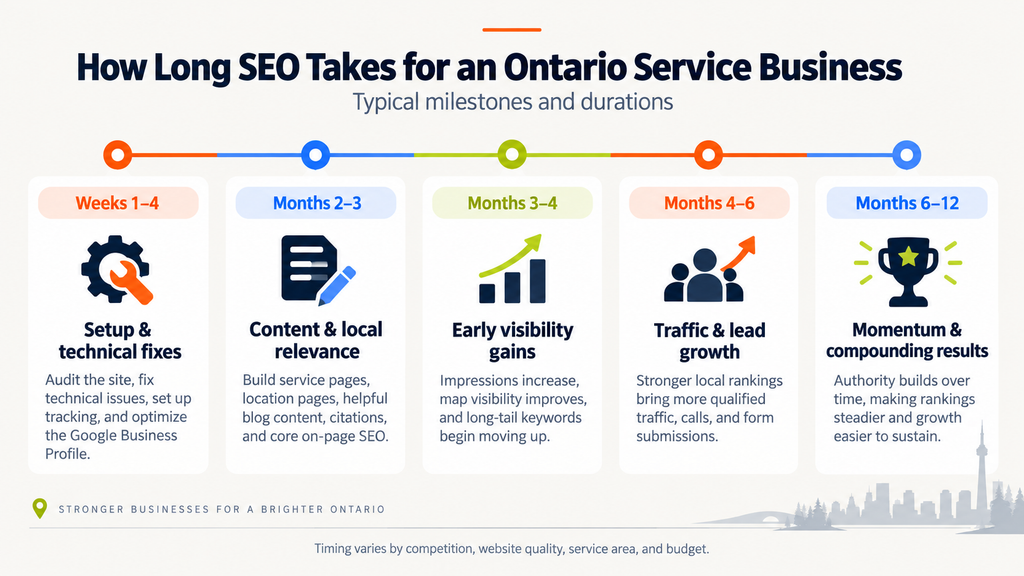
The Timeline at a Glance
The table below gives you the complete 12-month SEO timeline for an Ontario service business. Use it as your month-by-month benchmark for what should be happening and what signals to check.
| Month | Phase | Primary activity | What to check |
|---|---|---|---|
| 1 | Foundation | Technical audit, keyword research, on-page optimization | Google Search Console crawl errors, indexed pages |
| 2 | Foundation | Content creation starts, internal links built, structured data added | Indexed page count, Google Analytics organic sessions |
| 3 | Foundation → Traction | Content publishing accelerates, off-page work begins | Impressions rising in Search Console, keyword rankings appearing |
| 4 | Early traction | Link building outreach, local citations, Google Business Profile optimization | First page-two or page-three rankings on target keywords |
| 5 | Early traction | Content gaps filled, existing pages refreshed, technical fixes completed | Click-through rate improving, search terms expanding |
| 6 | Traction → Growth | Rankings consolidating on key search terms, leads starting from organic | First organic leads tracked in Google Analytics |
| 7–9 | Growth | Content compounding, backlink profile growing, search rankings moving to page one | Monthly organic traffic trending up, lead volume increasing |
| 10–12 | Compounding | Competitive keywords targeted, authority signals strengthening | Revenue attribution from organic search, cost-per-lead declining |
Timelines vary by industry competition, site history, and SEO investment level. Ontario competitive verticals (legal, dental, trades, finance) typically run 1–3 months longer at each phase.
What Search Engines Actually Measure
Before mapping the milestone timeline, it helps to understand what search engines are actually evaluating — because this determines what actions produce results at each stage, and why the timeline is structured the way it is.
Search engines evaluate hundreds of signals to determine where your pages appear in search results. These signals fall into three categories that map directly to the three types of SEO work: technical signals, on-page signals, and off-page signals.
Technical signals tell search engines whether your site is accessible, fast, and structurally sound.
Technical SEO ensures search engines can crawl and index your site — without this foundation, the other ranking signals are partially wasted regardless of content quality. Search engines discover new pages through web crawlers that follow links. If your site has crawl errors, the pages with errors are invisible to search engines regardless of content quality.
On-page signals tell search engines what each page is about and whether it matches what users search for.
This includes title tags, structured data, content relevance to target search queries, and the quality of the information provided. User interaction data may also evaluate content quality and relevance — meaning that pages users engage with are rewarded over pages users quickly abandon.
Off-page signals tell search engines how credible and authoritative your site is relative to other sites covering similar topics.
Backlinks from reputable external sources are the primary off-page signal — PageRank measures the strength of inbound links to a page. High-quality backlinks improve a site’s search engine rankings significantly, and building them legitimately is why the off-page phase of an SEO campaign takes months, not weeks.
Google’s mobile-first indexing means the mobile version of your site is what search engines primarily evaluate. If your mobile experience is poor — slow loading times, small text, broken layouts — your rankings will reflect that regardless of how good your desktop experience is.
Page speed is a critical factor in technical SEO rankings, and Core Web Vitals scores are a direct input into Google’s ranking decisions.
Understanding this three-part structure is what separates an effective SEO strategy from a fragmented one.
All three categories of signals need to be built simultaneously and consistently throughout the 12-month timeline — not sequentially with on-page first, then off-page after, and technical issues addressed only when they cause obvious problems.
Working Backwards: Building an SEO Strategy That Hits Real Milestones
The most common mistake Ontario service businesses make with SEO is working backwards from today’s date to the results they want, and expecting results before the work has had time to compound. Understanding what happens at each phase — and what actions drive each phase — is how you avoid that mistake.
The milestones below are structured the way Link Lumin runs client campaigns — for more on what each phase involves, see our full SEO services page. The timeframes are realistic averages for an Ontario service business starting from a typical website with some existing content and no significant technical penalties.
Months 1–2: The Foundation Phase — Technical Optimization, On-Page SEO, and Off-Page SEO
The foundation phase is the least visible phase of an SEO campaign and the most important one to get right. This is where technical SEO problems that block search engines from crawling and indexing your site are identified and fixed. This is where keyword research identifies the search terms your target audience actually uses. This is where on-page SEO aligns your existing pages with those terms.
Most Ontario service businesses discover three categories of technical issues at this stage.
First, crawl errors — pages that web crawlers cannot access due to broken links, incorrect redirects, or robots.txt misconfigurations. Second, indexing problems — pages that Google has discovered but not indexed because of thin content, duplicate content, or missing canonical tags. Third, site architecture issues — a site structure that makes it difficult for search engines to understand which pages are most important.
Fixing these problems before anything else is not optional.
Search engines use crawlers to index web pages — if those crawlers cannot reach your pages properly, no amount of content or link building will produce ranking improvements. Technical optimization is the prerequisite for everything that follows.
During this phase, you should also be building your internal links structure — connecting related service pages to each other so that search engines understand your site’s topical depth.
Internal links help search engines understand the relationship between your pages and distribute authority across your site. They also improve user experience by helping visitors navigate to related content.
What to check during months 1–2 in Google Search Console: crawl coverage report (are pages being indexed?), index coverage (are there errors blocking indexing?), and core web vitals (are pages loading fast enough to qualify for good user experience signals?).
In Google Analytics, confirm that organic search traffic is being tracked correctly and that your conversion goals are set up and recording.
The deliverables at the end of the foundation phase: a fully indexed site with no critical technical errors, a keyword research document mapping target search terms to pages, on-page optimization completed for your 10–15 most important pages, and a content plan for the next three months.
These deliverables are the evidence that the foundation phase was completed correctly — not the absence of ranking improvements, which are normal and expected at this stage.
Months 3–4: First Signals — Off-Page SEO, Local SEO, and Search Results
By month three, your pages should be properly indexed and your on-page work should be complete.
The question at this stage is whether search engines are beginning to recognize your site’s relevance for the search terms you are targeting. You will not be on page one of Google yet. But you should be seeing the first signals that the algorithm is starting to understand your pages.
The signals to look for in Google Search Console by month three: impressions on target search terms (meaning Google is showing your pages in search results, even if not in top positions yet), first keyword ranking appearances even in positions 15–50, and click-through rate data on any terms you are beginning to rank for.
If none of these signals are appearing by month three, that indicates either a technical problem that was not properly resolved in months 1–2, or a content and keyword strategy that is too broad to produce indexing signals in this timeframe.
Month three is also when off-page SEO work typically begins in earnest. Off-page optimization — building the external signals that tell search engines your site is credible and authoritative — includes link building from relevant external sources, local citation building in Ontario business directories, and Google Business Profile optimization for local search results.
For Ontario service businesses targeting local customers in Brampton, Mississauga, or the GTA, this local SEO work is often where the fastest early ranking movement appears. For a practical guide to local citation-building that works for Ontario businesses, see Boost local seo with business listings a simple guide — the most direct complement to the work happening at this stage.
Content creation is also accelerating by month three. The content plan from the foundation phase is now producing new pages targeting specific search queries.
Each piece of content is an additional indexed page, an additional opportunity to rank for relevant keywords, and an additional signal to search engines that your site has topical depth in your service area.
What to Confirm in Writing at Month Three
By the end of month three, your SEO provider should be able to show you in writing — in a structured monthly report, not just a verbal update:
- Which keywords your pages are now ranking for, and at what positions
- Impression data from Google Search Console showing search visibility growth
- The number of new pages indexed since the campaign started
- Link building progress — how many quality external links have been acquired
- Content published — what has gone live, what is planned, and what search terms each piece targets
- Technical issue resolution — confirmation that all critical issues from the audit have been fixed
If your SEO provider cannot produce this data clearly by month three, that is a significant concern. Legitimate SEO work is measurable throughout — not just at the end when results are supposed to appear.
The Detail Most Ontario Service Businesses Forget
Most Ontario service business owners focus entirely on when they will rank on page one of Google for their primary keyword. They forget to track the dozens of longer-tail search terms that their pages will rank for first — lower-competition keyword phrases that bring qualified local traffic before the main competitive keywords arrive. These early-ranking search terms are often the ones that convert best, because they are more specific and closer to purchase intent.
Why It Matters
Ignoring early-ranking search terms means missing the organic leads that start arriving before your main keyword rankings are established — and losing the data about which search terms actually convert for your business, which should directly inform your content strategy for months 4–12.
Months 5–6: Traction — SEO Strategy Consolidates in Search Results
By month five, a well-executed SEO campaign for an Ontario service business should show clear upward trends on multiple metrics. Search rankings should be moving toward the top of page two or beginning to appear on page one for some target keywords. Organic search traffic in Google Analytics should be growing month-over-month. And critically, the first organic leads or enquiries should be traceable to search.
The traction phase is also when content optimization of existing pages becomes important.
Pages that are ranking in positions 15–30 are close to the traffic-generating zone of page one — targeted updates to these pages, improving their relevance for the specific search query they are ranking for, can produce meaningful ranking improvements faster than creating new content from scratch.
Regularly updating content can lead to faster ranking boosts than creating entirely new pages, which is why content optimization is a standard part of Link Lumin’s month-five and month-six work.
During this phase, technical SEO maintenance continues. Google’s algorithm updates can significantly impact rankings — staying current with crawl errors, Core Web Vitals performance, and indexing status through Google Search Console is ongoing work, not a one-time task. Broken links that appear from site changes, new pages without proper title tags, or structured data errors can each suppress rankings that should be improving.
By month six, the question shifts from “is this working?” to “how fast is this compounding?” The metrics that matter at this stage: month-over-month organic traffic growth rate, organic lead or conversion rate from organic traffic, keyword ranking distribution across positions 1–10, 11–20, and 21–50, and search terms that were not in your original keyword research but are now driving traffic.
Use Google Analytics to track which organic traffic is converting, not just arriving. Traffic without conversion data is incomplete — and organic lead volume at month six is the metric that most directly predicts whether the campaign will produce a strong ROI by month twelve.
The last point is important.
As search engines develop a clearer understanding of your site’s topical authority, they begin ranking your pages for search terms you did not explicitly optimize for — related terms, question-based search queries, and long-tail variants of your main keywords.
This organic expansion of your keyword footprint is one of the clearest signs that an SEO campaign is working correctly.
Months 7–12: Compounding — Search Engine Authority and Growth
The compounding phase is what makes SEO fundamentally different from paid search results. Paid search requires ongoing payment for each click. Organic search traffic, once earned, continues delivering results without additional cost per visit. High-ranking organic search results generate ongoing traffic without paying for clicks — and the authority your site has built in months 1–6 continues compounding in months 7–12 without starting from zero.
In this phase, competitive keywords — the ones with high search volume and significant competition from established Ontario businesses — begin to become realistic targets.
The backlink profile built over months 3–6 is now providing domain authority that supports ranking for harder search terms. Content published in months 1–6 is compounding in authority as it earns links naturally and accumulates engagement signals.
The key activities in the compounding phase shift from building foundations to expanding coverage and protecting gains.
Expanding coverage means targeting additional high-value search terms, publishing content for previously uncovered search queries, and building out service-area pages for additional Ontario cities or neighbourhoods if relevant to your business.
Protecting gains means monitoring for algorithm updates that affect your rankings, refreshing older content that is beginning to lose positions, and maintaining technical SEO standards as your site grows.
By month twelve, a well-run SEO campaign for an Ontario service business should produce measurably different business outcomes: more organic leads, a lower cost-per-lead than paid search, a growing share of total traffic from organic sources, and a site that would cost significantly more to replicate today than it did twelve months ago.
That accumulated authority is the real return on SEO investment — not any individual ranking, but the compound effect of twelve months of consistent technical, content, and off-page work.

Sizing It Correctly: What Determines Your Timeline
Not every Ontario service business has the same SEO timeline. The variables below are what Link Lumin assesses during the discovery phase of every new engagement, because they directly determine how long each phase takes and what investment is required to hit each milestone.
How Domain History Affects Your SEO Timeline
Domain age and prior SEO history is the single most important factor after industry competition. A new domain with no history, no indexed pages, and no backlinks is starting from zero — and Google’s assessment of new domains takes time regardless of how good the technical setup is. An established site that has been live for 3–5 years with some organic traffic and a clean technical foundation will typically see traction by month 3–4 rather than month 5–6.
How Ontario Market Competition Shapes the Timeline
Industry competition in your Ontario market determines how much content, authority, and technical quality you need to compete on your target search terms. A roofing company in a smaller Ontario city competes against far fewer established domains than a personal injury law firm in Toronto. The roofing company might see page-one results for key terms in month 4–5; the law firm might be in month 10–12 for equivalent competitive keywords.
Website technical condition at the start of the campaign sets the length of the foundation phase. A site with serious crawl errors, hundreds of broken links, poor Core Web Vitals, or a site architecture that makes it difficult for search engines to understand the relationship between pages requires a longer foundation phase before traction can begin. In the most severe cases, significant technical remediation can add 2–3 months to the overall timeline.
Content volume and quality at campaign start. A site with 50+ well-structured service pages and location pages already in place has a significant head start over a site with a homepage and three service pages. The content gap between where you are and where you need to be in your category directly affects how long it takes to reach the compounding phase.
Local SEO vs National SEO — How Targeting Scope Affects Results
Local versus national or regional targeting affects difficulty and timeline. Ontario local SEO — targeting a specific city or service area — is generally faster to produce results than provincial or national campaigns because the geographic scope of competition is smaller. Search engines work to understand geographic relevance, and strong local signals (Google Business Profile, local citations, service-area pages) can accelerate local ranking timelines meaningfully.
AI Search and the New SEO Timeline Reality
AI search and generative engine optimization is an emerging factor in 2026 timelines. As Google AI Overviews and other AI search features appear in more Ontario search results, traditional organic results are being pushed down the search results page. Businesses whose SEO strategies do not account for AI-driven discovery may see traffic from organic search decline even as their rankings hold. Answer engine optimization and generative engine optimization — ensuring your content appears in AI-generated answers — is increasingly a timeline consideration alongside traditional search engine rankings. The Link Lumin approach covers both traditional SEO and AI search visibility from the start.
Budget: What Each Phase of the Timeline Costs
The timeline above assumes a properly resourced SEO campaign. Underfunding any phase of the plan extends the timeline — in some cases significantly.
Foundation phase investment (months 1–2): C$1,500–C$3,500 total depending on site size and technical complexity.
This covers the technical audit and remediation, keyword research, on-page optimization of core pages, and initial content planning. Larger sites with complex technical issues or extensive on-page work required will be toward the top of this range.
Growth phase monthly investment (months 3–6): C$1,500–C$4,500/month for an Ontario service business with moderate competition.
This covers ongoing technical maintenance, content creation (2–4 pieces per month), link building and off-page work, Google Business Profile management, and monthly reporting. Highly competitive Ontario verticals — legal, dental, trades, financial services in the GTA — will need the upper end of this range to compete effectively.
Compounding phase monthly investment (months 7–12): C$2,000–C$5,000/month for businesses expanding keyword coverage and protecting gains.
This phase typically requires more content production, more competitive link acquisition, and in some cases AI search optimization work as answer engine optimization becomes a measurable part of Ontario search results.
In-house versus agency: In-house SEO teams cost over C$40,000 per person annually in salary before tools, training, or management overhead.
An agency retainer covers an entire team — including technical specialists, content writers, and link builders — for a fraction of that cost. For most Ontario service businesses, the agency model delivers better results at lower total cost, particularly in the first 12 months.
For businesses that serve markets beyond Ontario — including the US — the same timeline framework applies: foundation phase, traction phase, and compounding phase map directly to any English-speaking competitive market, with slight adjustments for domain authority baseline and competitive density.
What Goes Wrong, and How to Avoid It
Three failure modes account for the majority of unsuccessful SEO campaigns for Ontario service businesses.
Failure mode one: underfunding the foundation phase.
The most common mistake is spending the majority of the budget on content and link building before the technical foundation is solid. Content published on a site with crawl errors, poor site architecture, or missing structured data will rank more slowly and less reliably than the same content on a technically clean site.
If your SEO provider is pushing to start publishing content and building links before the technical audit is complete and the issues are fixed, that is a process problem that will cost you months of timeline.
Failure mode two: stopping at month three.
SEO takes time, and month three is typically the point of maximum doubt — impressions are growing in Google Search Console, but page-one rankings and organic leads have not arrived yet.
Businesses that cancel their SEO campaign at month three because they “haven’t seen results” have paid for the entire foundation phase without staying long enough to see the return. The majority of the ROI from an SEO campaign arrives in months 6–12, not months 1–3.
Failure mode three: targeting the wrong search terms.
Keyword research that focuses on high-volume, broad search terms — the obvious terms everyone in your industry is targeting — leads to long timelines and marginal results for most Ontario service businesses.
The more effective approach targets a mix of competitive terms for the long-term, and lower-competition, higher-intent local search terms for early traction. An SEO specialist who cannot explain this distinction clearly during the proposal stage is likely to deliver a keyword strategy that takes twice as long to produce results.
How Link Lumin Runs It in Brampton
Link Lumin manages SEO campaigns for Ontario service businesses from Brampton. Our process follows the timeline above, with a monthly reporting cadence that gives every client a clear view of what happened, what it produced, and what happens next.
In the foundation phase, every campaign starts with a full technical audit, a keyword research document mapped to your specific Ontario market and service area, and on-page optimization of your core pages.
No content is published and no link building begins until the technical foundation is solid. This is not optional — it is the difference between a campaign that compounds and one that stalls.
In the growth phase, we build content and authority in parallel. Content targeting the search terms your customers actually use. Links from credible, relevant Ontario and Canadian sources.
Google Business Profile management that builds your local search presence alongside your organic rankings. Monthly reporting that ties all of this to business outcomes — not just rankings.
Our SEO services are built around deliverable-led monthly retainers. Every client receives a written deliverable list, monthly performance reports covering organic traffic, search rankings, and lead attribution, and a monthly strategy call with their account manager. Contact us at (647) 699-2555.
View everything we offer at Link Lumin services.
Frequently Asked Questions
How long does SEO take to show results for a local service business in Ontario?
Most Ontario local service businesses see first ranking signals — impressions and early positions on target search terms — by month two or three. Meaningful page-one rankings typically appear in months four to six for lower-competition terms, and months seven to twelve for competitive terms in the GTA. Local SEO in lower-competition Ontario markets often moves faster because the geographic scope of competition is smaller.
What is the difference between organic search and paid search in Google Analytics and search results?
Organic search traffic is free per click once rankings are earned — but requires three to twelve months of consistent SEO investment before producing significant volume. Paid search results appear above organic results and can deliver traffic immediately, but stop the moment you stop paying. Organic search accounts for 53% of all site traffic versus around 15% for paid search. Most Ontario service businesses benefit from both channels, using paid search for immediate leads while SEO builds long-term organic traffic.
Can on-page SEO and content optimization speed up results — and which search terms show improvement first?
Yes — significantly. On-page SEO that closely aligns each page with a specific search query and user intent accelerates ranking timelines by giving search engines clearer signals about what each page is about. Content optimization of pages already ranking in positions 15–30 can push them to page one faster than creating new content from scratch. Google Analytics and Google Search Console together show you which pages are closest to page-one rankings, making content optimization decisions data-driven rather than guesswork.
What happens if I stop SEO at month three — and should I hire an SEO specialist or an agency?
Stopping at month three means paying for the entire foundation phase — technical audit, on-page optimization, initial content — without staying long enough for the compounding phase to begin. Rankings earned in months 1–3 will typically begin to decline within 3–6 months without ongoing work. Your competitors who stayed consistent will move into the positions you earned. Restarting an SEO campaign from scratch after a gap costs more and takes longer than maintaining consistent monthly work through the full timeline.
About Link Lumin
Link Lumin is a North York, Ontario digital marketing and SEO agency serving Ontario service businesses across the Greater Toronto Area and beyond. We specialize in local SEO, technical SEO, content strategy, and AI search optimization. Our team manages the full SEO timeline — from technical foundation through compounding growth — with transparent monthly deliverables and reporting that ties every action to business outcomes. Contact us at (647) 699-2555.
Service Area
Link Lumin serves Brampton, Mississauga, Toronto, North York, Etobicoke, Oakville, Burlington, Hamilton, Markham, Richmond Hill, Vaughan, Whitby, and Oshawa. We work with service businesses across Ontario — from single-location local businesses in Brampton to multi-location Ontario service businesses targeting regional search results.
Next Step
Ready to understand exactly what your Ontario SEO timeline looks like? Contact Link Lumin today for a free consultation and a milestone-matched plan for SEO services built around your specific market and business targets.