





Closed-loop marketing is a data-driven strategy that traces every lead — from the keyword or channel that first attracted them to the point of sale — and feeds that outcome back into future decisions. Ontario businesses using this approach know exactly which marketing efforts generate revenue. Link Lumin builds these systems so that marketing spend is accountable at the keyword level.
For Ontario marketing and sales teams, business owners, and digital marketing managers who want to move from campaign reporting to revenue attribution.
Key Takeaways
Closed-loop marketing connects marketing activities directly to sales outcomes — closing the gap between the marketing team and the sales team.
CRM systems are essential for closed-loop marketing integration. Without a customer relationship management platform linking lead sources to sales records, the loop cannot close.
Google Analytics is used by over 50% of top websites, but without CRM integration it shows traffic, not revenue.
Closing the loop requires connecting both systems — the analytics platform that captures the marketing source, and the CRM that records the deal.
Data feedback loops verify which marketing efforts result in actual revenue generation — not just which campaigns generate the most clicks or impressions.
The four-step process covers: tracking, lead conversion, sales engagement, and data analysis that feeds back into campaign decisions. Link Lumin’s SEO reporting applies this at the keyword level for Ontario clients.
Closed-Loop Marketing, Defined
Closed-loop marketing is a data-driven strategy that connects customer acquisition data to sales outcomes by creating a continuous feedback loop between marketing and sales. A visitor arrives on a landing page from a specific keyword or channel. That interaction is tracked through the entire customer journey — from first touch to closed deal. The sales outcome — whether a deal was won or lost — is fed back to the marketing team, who use it to adjust campaigns, reallocate budget, and refine targeting. The loop is closed when sales outcomes inform future marketing decisions, not just traffic and lead-count metrics.
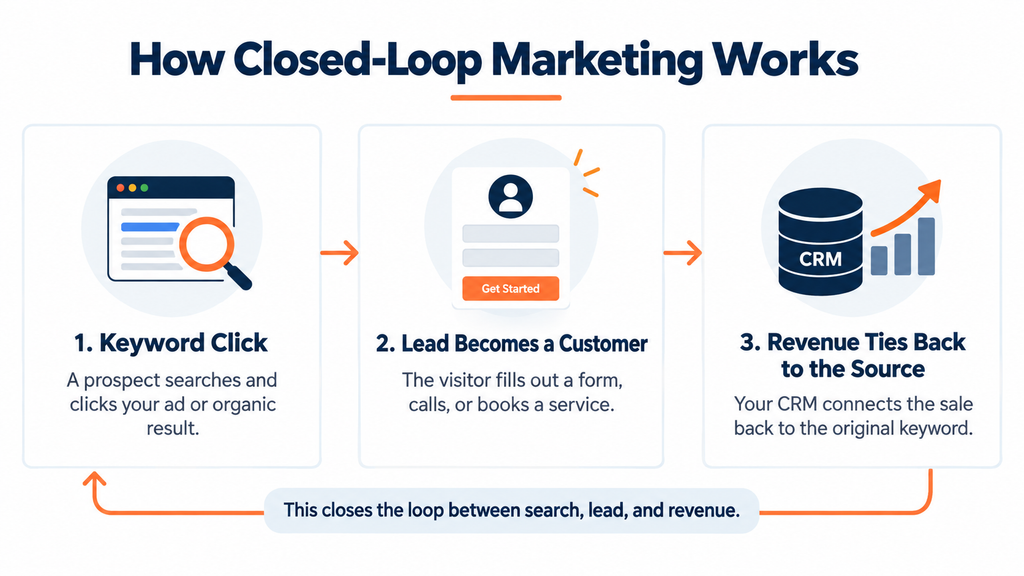
How Closed-Loop Marketing Works
The mechanism of closed-loop marketing is straightforward: data flows from marketing into sales, and then back from sales into marketing in a continuous cycle. What makes it powerful is the precision — every lead is traceable to its originating keyword or channel, and every sales outcome is attributable to the marketing activity that produced the lead.
Step by Step
The closed-loop marketing process runs through four stages in every campaign cycle.
Stage One: Tracking and Data Collection From Landing Pages
When a visitor lands on your site, tracking technology — including tracking cookies and UTM parameters — captures the source, medium, keyword, and landing page that brought them there.
This data collection step is the foundation. Without it, the loop never opens. Marketing automation platforms and Google Analytics capture these touchpoints at the session level, tagging each visitor with their originating keyword or channel.
The data captured typically includes: traffic source, keyword, landing page, pages visited, and actions taken.
For Keyword research to feed a closed-loop system, those keywords need to be tagged at the campaign and ad-group level so individual terms can be connected to individual leads.
Stage Two: Lead Conversion and CRM Integration
When a visitor converts — fills a form, calls a tracked number, or books an appointment — their originating source data must be passed into the customer relationship management software alongside their contact details.
This is the critical integration step. Without it, the marketing data and the lead record exist in separate systems, and the loop cannot close.
Most CRM systems capture UTM parameters automatically when forms are correctly configured. The lead record now carries the keyword, campaign, and channel. Every subsequent interaction — the sales call, the proposal, the follow-up — is logged against that same record.
Stage Three: Sales Engagement and Outcome Recording
The sales team works the lead through the sales process — qualified, proposal sent, won or lost — with each stage recorded in the CRM.
Sales and marketing teams without a shared platform work from different data sets, which is why CRM integration is the prerequisite for closed-loop marketing.
When a deal closes, the CRM has a complete record: the keyword, campaign, channel, time to close, and revenue value. When a deal is lost, the same data is available — allowing the marketing team to understand not just which channels produce leads, but which ones produce leads that convert.
Stage Four: Data Analysis and Campaign Feedback
The loop closes when sales outcome data flows back to the marketing team. CRM data is exported or connected to a reporting dashboard where keyword-level revenue attribution becomes visible: which keywords produced leads that closed, which campaigns generated high volume but low close rates, and which channels have the lowest cost per acquired customer.
This analysis transforms raw data into actionable insights. Budget allocation is adjusted — scaling spend on keywords and channels that produce closed deals, reducing spend on those that produce leads without revenue. Campaign messaging is refined based on what the sales team reports about objections and qualified enquiries.
The feedback loop restarts at Stage One and becomes more accurate with every completed cycle — which is why businesses with mature closed-loop systems consistently outperform those operating on campaign-level reporting alone.
The Main Types of Closed-Loop Marketing Systems
Not every closed-loop marketing setup works the same way. The two primary types differ in integration depth and the granularity of data they return to the marketing team.
Type Comparison Table
| Single-touch closed loop | Multi-touch closed loop | |
|---|---|---|
| Attribution model | First touch or last touch only | Credits all touchpoints proportionally |
| CRM integration depth | Basic — source and medium captured | Advanced — full journey mapped |
| Best for | Simple funnels, direct response campaigns | Complex B2B funnels, long sales cycles |
| Data management | Straightforward, lower setup cost | More complex, requires data warehouse |
| Feedback to marketing | Which channel opened or closed the deal | Which combination of channels produced revenue |
| Tools typically used | Google Analytics + basic CRM | Marketing automation + CRM + attribution platform |
Type One: Single-Touch Closed-Loop Attribution
Single-touch closed-loop marketing assigns the revenue from a closed deal to either the first channel that touched the lead (first-touch attribution) or the last channel before conversion (last-touch attribution). It is simpler to implement and requires less advanced CRM integration.
For Ontario service businesses with short sales cycles — a plumber who responds to an inbound call and closes the same day — single-touch attribution is often sufficient. The keyword that generated the call gets credit for the revenue. The marketing team can see which keywords produce revenue, not just leads, and reallocate budget accordingly.
Best Suited To
Small and mid-sized Ontario businesses, service businesses with direct-response funnels, and any organization where the gap between first contact and closed deal is short enough that the originating keyword or channel is the most meaningful attribution point.
Limitation to Know
Single-touch attribution undervalues the middle of the customer journey — the email campaign that nurtured the lead for three weeks gets no credit, even if it was decisive in the buying decision.
Type Two: Multi-Touch Closed-Loop Attribution
Multi-touch closed-loop marketing distributes revenue credit across all the touchpoints a lead encountered before closing. A lead might have found the business through organic search, been retargeted on social media, opened three email campaigns, and then returned via a branded search to book. Multi-touch attribution assigns credit to each of those touchpoints proportionally.
This model requires a more sophisticated data management infrastructure — typically a marketing automation platform, a CRM, and either a dedicated attribution tool or a data warehouse that connects them. The payoff is a significantly more accurate picture of how marketing channels work together, which is essential for Ontario businesses running complex multi-channel campaigns or serving enterprise clients with long decision timelines. For businesses using artificial intelligence-driven attribution and campaign management, see Ai marketing for how Link Lumin applies AI to this work.
What Closed-Loop Marketing Is Not
Three things closed-loop marketing is regularly confused with, each worth distinguishing clearly.
It is not the same as marketing analytics.
Standard marketing analytics — Google Analytics, social media reporting, email campaign dashboards — tells you about traffic, engagement, and leads. Closed-loop marketing connects those upstream metrics to downstream sales outcomes.
Analytics shows you how many people clicked an ad. Closed-loop marketing tells you how many of those people became paying customers, and what they were worth.
It is not just CRM reporting. A CRM without integration to the marketing data sources that produced its leads is not a closed-loop system. Closed-loop marketing requires both sides — the marketing activity that created the lead and the sales outcome that closed it — connected in a single view. For the technical implementation, see Closed loop analytics.
It is not a campaign reporting tool. Campaign reporting covers impressions, clicks, and cost per lead. Closed-loop marketing tells you how a campaign performed on business terms — revenue, customer acquisition cost, marketing ROI. A campaign generating cheap leads that never convert will look like a success in campaign reporting; closed-loop marketing makes the gap immediately visible.
The closest existing guide to how these concepts apply across advertising campaigns specifically is at 7 expert ad marketing tips for crafting powerful advertising campaigns — worth reading alongside this one for the campaign-level execution detail.
Who Closed-Loop Marketing Suits in Ontario
Ontario businesses that benefit most from closed-loop marketing share a common characteristic: they have multiple marketing channels running simultaneously and no reliable way to determine which ones are producing revenue.
This is the core problem closed-loop marketing solves — replacing guesswork with precise attribution that shows exactly which spend is working.
A Brampton professional services firm running Google Ads, social media, and organic search in parallel cannot tell from channel-level reporting which investment is producing clients.
Without a closed-loop system, budget decisions rely on cost-per-lead data that may be misleading — a channel producing cheap leads that rarely close is worse than one producing fewer, more expensive leads that close consistently.
For Ontario service businesses, the most immediately actionable version of closed-loop marketing is connecting phone calls and form submissions to their originating keywords in the CRM, then tracking those leads through to won or lost status.
This alone — without full multi-touch attribution — provides enough data to reallocate a Google Ads budget from keywords that generate calls to keywords that generate closed deals.
The broader market research argument for closed-loop marketing in Ontario: as AI search and generative AI answers change how customers discover businesses, the customer journey is becoming more complex, not less.
A lead in 2026 may discover a business through an AI overview, research it on social media, and convert through organic search — all before making contact. Closed-loop data management across these touchpoints is what allows marketing and sales teams to understand and optimize for that journey.
Our SEO reporting connects keyword performance to lead outcomes — giving Ontario clients the closed-loop view of which search terms produce revenue. Contact us at (647) 699-2555.
Frequently Asked Questions
What is closed loop marketing work, and what feedback loop does it create for customer acquisition?
Closed-loop marketing is a data management system that connects every lead back to the marketing activity that produced it — tracking the full journey from keyword or channel to sale. The sales team records deal outcomes in the CRM, and that data feeds back to the marketing team. This feedback loop allows marketing decisions to be based on revenue outcomes, not just lead volume or campaign click metrics.
What tools do I need for a closed-loop marketing strategy — including customer relationship management?
A basic closed-loop marketing strategy requires three components: a tracking system that captures source data at the point of conversion (UTM parameters, Google Analytics, or marketing automation), a customer relationship management platform that stores lead records with their originating source, and a process for the sales team to record deal outcomes in that same CRM. Marketing automation platforms like HubSpot and CRM systems like Pipedrive and Salesforce are commonly used for this integration.
How does closed-loop marketing improve data management, data driven decision making, and market research?
Closed-loop marketing generates first-party data about which channels and keywords produce revenue in your specific market — more reliable than benchmarks because it reflects your actual customer acquisition data. Over time, this enables genuine market research into which customer segments convert best and which channels produce the highest lifetime value customers.
Is closed-loop marketing worth it for a small Ontario business — and does it require a formal marketing plan?
For most Ontario small businesses, the basic version — connecting form submissions and phone calls to their originating keywords, and tracking those leads through the sales process in a CRM — is achievable with tools that cost well under C$200/month. The data collection produced pays back that investment quickly by identifying which ad spend or SEO channels are generating paying customers versus traffic that never converts. Landing pages connected to closed-loop tracking typically reveal conversion rate gaps within the first 30–60 days.
About Link Lumin
Link Lumin is a North York, Ontario digital marketing agency specializing in SEO, closed-loop analytics, and campaign reporting. We help Ontario businesses connect their marketing spend to measurable revenue outcomes, tying keyword performance, campaign data, and CRM outcomes into a single transparent view. Contact us at (647) 699-2555.
View the full range of what we offer at Link Lumin services.
Service Area
Link Lumin serves Brampton, Mississauga, Toronto, North York, Etobicoke, Oakville, Burlington, Hamilton, Markham, Richmond Hill, and Vaughan across Ontario. Our closed-loop marketing and SEO reporting work is built around the specific channels, customer journeys, and competitive dynamics of the Ontario market.
Next Step
Ready to know which keywords are actually producing customers — not just traffic? Contact Link Lumin today for a free consultation on SEO reporting that connects every lead to the keyword that made it.