





Key Takeaways
- E-E-A-T stands for Experience, Expertise, Authoritativeness, and Trustworthiness.
- It is not a direct ranking factor — but it shapes how Google’s algorithms evaluate content quality.
- Small businesses can demonstrate all four components without a large budget.
- Trust is the most critical component of E-E-A-T according to Google.
- AI-generated content does not automatically satisfy E-E-A-T — human experience does.
- First-hand experience, visible credentials, and accurate information are the fastest wins.
Introduction
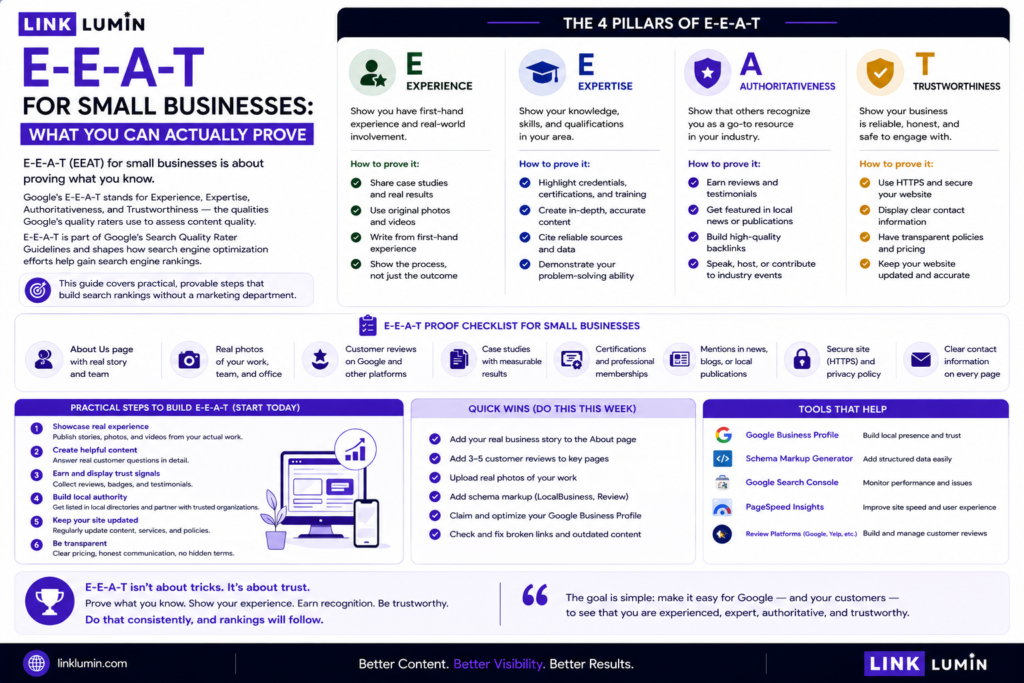
E-E-A-T (EEAT) for small businesses is about proving what you know. Google’s E-E-A-T stands for Experience, Expertise, Authoritativeness, and Trustworthiness — the qualities Google’s quality raters use to assess content quality. E-E-A-T is part of Google’s Search Quality Rater Guidelines and shapes how search engine optimization efforts help gain search engine rankings. This guide covers practical, provable steps that build search rankings without a marketing department.
What E-E-A-T Actually Means
Google’s E-E-A-T is not a single automated ranking score. It describes qualities that search algorithms recognize over time.
Experience — the practical involvement of the content creator. Did you actually do the thing you are writing about?
Expertise — formal knowledge or credentials possessed by the creator. Do you have relevant qualifications?
Authoritativeness — the overall reputation of the creator within their industry. Do reputable sites reference or link to you?
Trustworthiness — the transparency, accuracy, and reliability of the content. Is your business information complete and honest?
Trust is the most critical component of E-E-A-T according to Google. Without it, the other three cannot compensate.
Is E-E-A-T a Ranking Factor?
E-E-A-T is not a direct ranking factor. There is no E-E-A-T score in Google’s algorithm. But E-E-A-T is not just theoretical either.
E-E-A-T is not a direct ranking factor — there is no single score in Google’s systems. Instead, quality raters assess these signals and their feedback helps Google determine which content deserves better search visibility and higher rankings. For creating high-quality content that gains search engine rankings, demonstrating E-E-A-T is essential — especially for topics affecting a person’s life, well-being, or financial stability.
Why It Matters More for YMYL Topics
E-E-A-T is crucial for YMYL topics like health and finance. Greater weight is placed on strong E-E-A-T for sensitive topics due to their impact on well-being.
If your business operates in legal, financial, or medical areas, your content faces a higher bar. Adequate expertise must be demonstrated clearly. Quality raters look for an authoritative or trustworthy source — not just target keywords.
What Small Businesses Can Actually Prove
Here is where practical application begins. These are provable signals, not aspirational ones.
Prove Experience: Show You’ve Done It
Experience refers to first-hand involvement. This is your biggest advantage over AI generated content.
- Share real outcomes from your own business.
- Use photos from your actual work — not stock images.
- Write blog posts in first person about specific situations you handled.
- Include case studies with real results.
Demonstrating first-hand experience and providing accurate citations improves E-E-A-T. Content created from genuine experience consistently outperforms generic content in search results.
Prove Expertise: Make Credentials Visible
Expertise is the formal knowledge or credentials possessed by the creator. For small businesses, it often exists — it just isn’t visible.
- Add author bios to all blog posts.
- List relevant qualifications, certifications, and years of experience.
- Link to professional memberships and associations.
- Keep bios updated with up to date information.
If your content creator has subject matter expertise, make it explicit. Google uses this context to assess adequate expertise for the topic.
Prove Authoritativeness: Build Your Reputation Off-Page
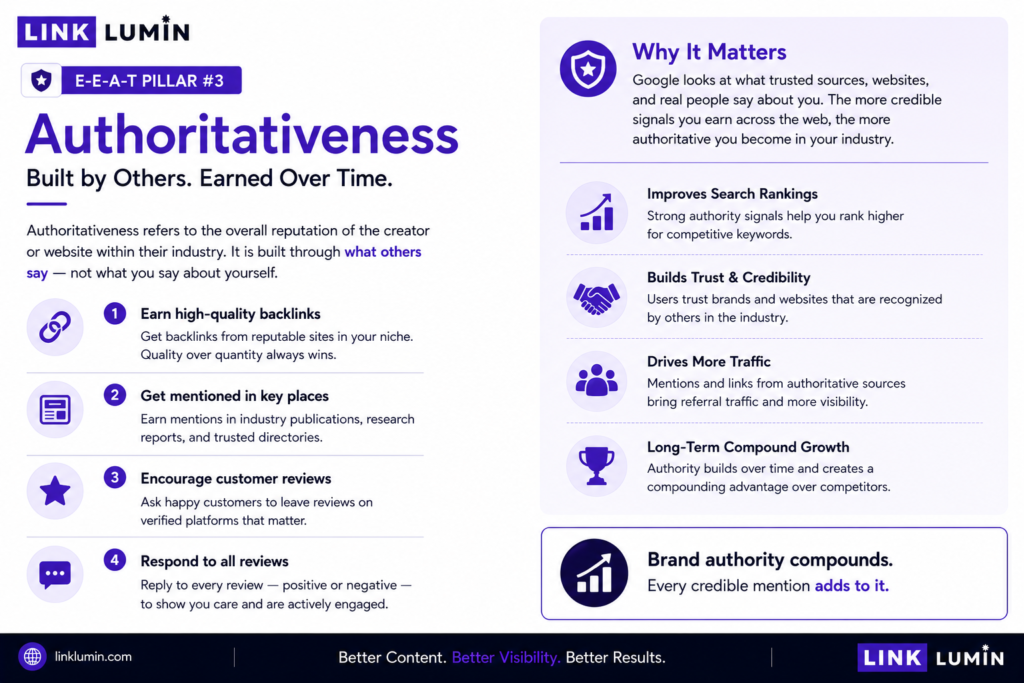
Authoritativeness refers to the overall reputation of the creator or website within their industry. It is built through what others say — not what you say about yourself.
- Earn high-quality backlinks from reputable sites in your niche.
- Get mentioned in industry publications, research reports, and directories.
- Encourage customers to leave reviews on verified platforms.
- Respond to all reviews to show active engagement.
Brand authority compounds. Every credible mention adds to it.
Prove Trustworthiness: Remove Every Doubt
Trust is the foundation. Trustworthiness measures the transparency, accuracy, and reliability of the content — and of your business itself.
Minimal customer service information on a website is a trust signal failure. Audit yours:
- Is your address, phone number, and email clearly displayed?
- Is your customer service information accurate and easy to find?
- Do your web pages have privacy policies where required?
- Is your existing content factually accurate and current?
Google prioritizes trustworthy content that benefits users. Valuable content goes beyond keywords — it includes transparent business information that gives users confidence and strengthens brand credibility.
Content Strategy for E-E-A-T
Creating content that satisfies E-E-A-T requires a deliberate content strategy.
Quality over volume. Web content with thorough research delivers substantial value and outperforms thin content in SEO rankings.
Topical authority. Site owners who cover their niche consistently signal depth, building brand credibility and SEO success.
User intent alignment. Content should match what the intended audience wants — improving organic traffic and own content performance over time.
Regular updates. 78% of businesses audit their content assets at least once a year (Content Marketing Institute, 2024). Search quality raters guidelines reward accurate, current web content.
Avoid unreviewed AI content. AI generated content without human oversight doesn’t demonstrate experience or genuine expertise.
| E-E-A-T component | What it means | How to prove it |
|---|---|---|
| Experience | You have done the thing firsthand | Case studies, photos, first-person examples |
| Expertise | You have knowledge or credentials | Author bios, qualifications, certifications |
| Authoritativeness | Others recognise your credibility | Backlinks, press mentions, reviews |
| Trustworthiness | Your site and content are reliable | Contact info, accurate content, consistent NAP |
Practical Tips You Can Apply This Week
- Add author bios to every blog post on your site.
- Publish one case study from a real client interaction.
- Audit your contact page for completeness and accuracy.
- Check web pages for outdated statistics or broken links.
- Fill content gaps using keyword research and informative content.
- Request a quality backlink from an industry association or local directory.
- Cite reputable sources to support claims with reliable information.
Google recommends creating helpful, people-first content. These steps align directly with that goal.
What E-E-A-T Is Not
Avoid common misconceptions:
- E-E-A-T is not achieved by adding schema markup alone.
- It is not satisfied by producing more content — content quality matters more.
- Social media posts do not directly build E-E-A-T, though brand visibility helps.
- It is not a one-time fix — it is an ongoing standard.
E-E-A-T principles apply to the entire site. A site with some high-quality content and some thin content sends mixed signals to quality raters.
The Verdict
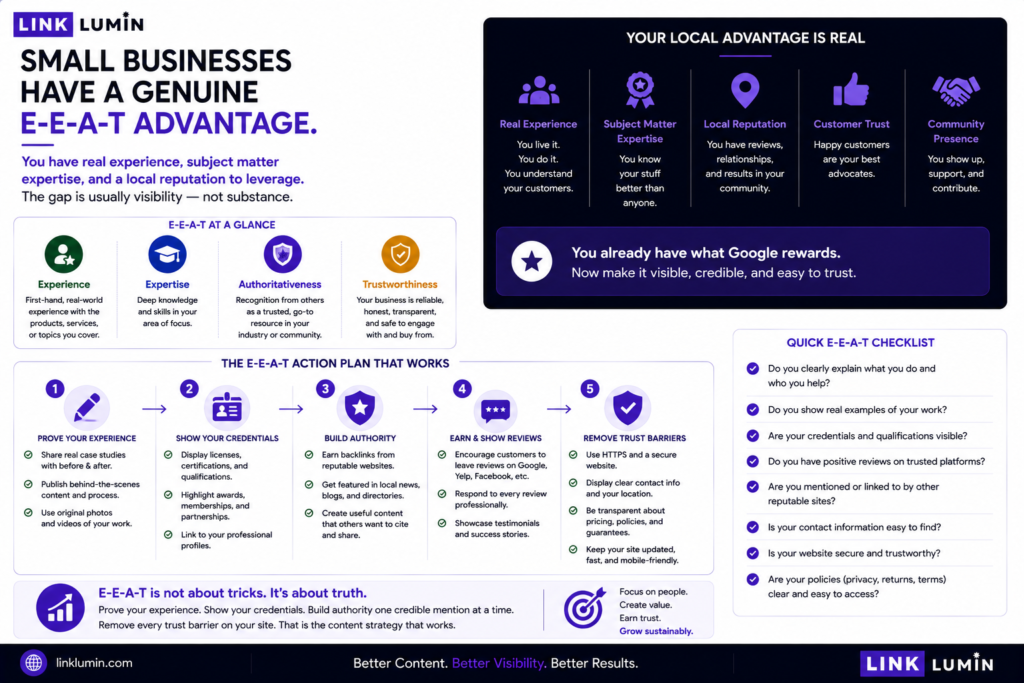
Small businesses have a genuine E-E-A-T advantage. You have real experience, subject matter expertise, and a local reputation to leverage.
The gap is usually visibility — not substance. Prove your experience. Show your credentials. Build authority one credible mention at a time. Remove every trust barrier on your site. That is the content strategy that works.
FAQs
1. What is E-E-A-T, and why does it matter for small businesses?
E-E-A-T stands for Experience, Expertise, Authoritativeness, and Trustworthiness — the framework Google’s quality raters use to assess content quality. It is part of the Search Quality Rater Guidelines and influences search engine rankings indirectly through the signals it trains Google’s systems to reward. Small businesses with genuine first-hand expertise are well-positioned to demonstrate strong E-E-A-T. The gap is usually visibility, not substance — make your credentials and experience explicit on every page.
2. Is E-E-A-T the same as E-A-T, and what changed?
E-A-T was Google’s original framework. E E A T expanded it in December 2022. Content created under E A T guidelines still counts — first-hand experience is now explicitly valued. E-E-A-T is the current standard in Google’s Search Quality Rater Guidelines. For small business owners with real field experience, this works directly in their favour.
3. Does AI-generated content hurt E-E-A-T?
Not automatically — but it rarely helps. AI generated content does not demonstrate first-hand experience or genuine expertise. Google’s quality raters assess whether content created shows authentic knowledge and credibility. AI tools assisting a credentialed expert can produce quality content. But AI content published without human oversight, named authorship, or evidence of real experience will not build brand authority or improve search engine rankings over time.
4. How do I create content that demonstrates E-E-A-T?
Start with first-hand knowledge. Writing from real experience, citing reputable sources, and displaying author credentials are the three fastest ways to demonstrate E-E-A-T. Google evaluates experience, expertise, authoritativeness, and trustworthiness together — content created by a named expert with verifiable credentials outperforms generic material. Your strategy must include named authors, accurate business information, high-quality backlinks, and regular content updates. Produce material your audience would share and cite.
5. Is E-E-A-T more important for some businesses than others?
Yes. Google places greater weight on strong E-E-A-T for topics affecting well-being, financial stability, or health — known as YMYL. Businesses in legal, financial, medical, or safety fields face a higher standard. However, Google E-E-A-T evaluations apply to all content types. Every small business benefits from demonstrating trust, transparency, and genuine expertise — regardless of industry or size of their online content output.