





Key Takeaways
- Backlinks are widely considered one of Google’s most important ranking signals.
- Quality beats quantity — one editorial backlink outperforms dozens of low-quality links.
- Dofollow links pass ranking value; nofollow links drive traffic but not equity.
- Toxic backlinks can trigger manual penalties — audit yours regularly.
- Guest posts, broken link building, and original research remain the most reliable tactics.
Introduction
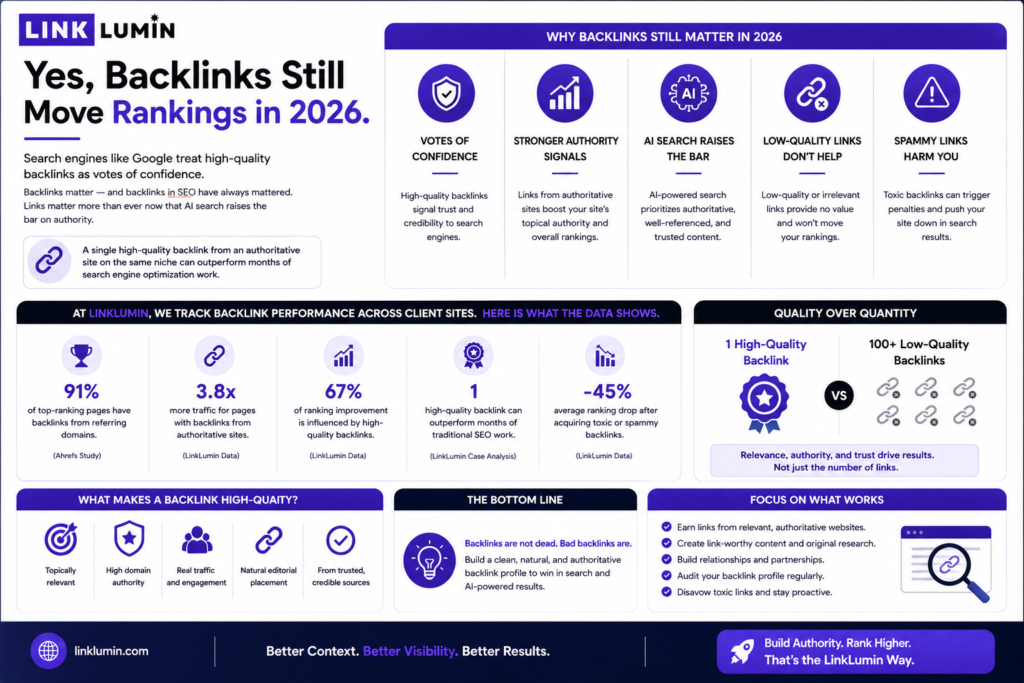
Yes, backlinks still move rankings in 2026. Search engines like Google treat high-quality backlinks as votes of confidence. Backlinks matter — and backlinks in SEO have always mattered. Links matter more than ever now that AI search raises the bar on authority. Low quality links no longer help, and spammy backlinks actively harm you. A single high-quality backlink from an authoritative site on the same site niche can outperform months of search engine optimization work. At LinkLumin, we track backlink performance across client sites. Here is what the data shows.
What Are Backlinks and Why Do They Matter?
Backlinks are hyperlinks from one website to a page on another website. Search engines view backlinks as a vote of confidence or recommendation.
When a relevant, trusted site links to your page, it tells search engines that your content is credible. Backlinks signal trust and authority to search engines. Pages with more high-quality backlinks tend to rank higher on search engine results pages.
Backlinks also drive direct referral traffic to your site. They help search engines discover and index new content — especially for new pages with no existing links pointing to them.
Dofollow vs Nofollow: What Is the Difference?
Not all backlinks are equal. The link attribute determines whether a link passes value. Dofollow links pass link equity and improve search rankings. This is the default for most outbound links on other sites. In HTML, a standard dofollow link looks like: <a href=”https://example.com”>text</a> — no extra attribute needed to pass full SEO value.
Nofollow links carry the rel=”nofollow” attribute — signalling that search engines should not pass ranking credit. Individual links marked nofollow do not pass SEO value but still drive referral traffic.
User generated content links — blog comments, forums, community posts — are typically nofollow, as are social media links. Dofollow links from authoritative referring domains move rankings. Nofollow links still matter for a natural link profile.
What Makes a Backlink High Quality?
One high-quality link from a respected site outweighs many low-quality links. Here is what separates good links from harmful ones.
| Link type | Source | Passes equity? | Risk level |
|---|---|---|---|
| Editorial backlink | Authoritative site, naturally earned | Yes | Low |
| Guest post link | Relevant niche site, genuine content | Yes | Low–medium |
| Paid link | Any site, purchased | Technically yes | High — violates Google guidelines |
| Link exchange | Reciprocal arrangement | Diluted | Medium–high |
| User-generated content | Forum, blog comment, social | No (nofollow) | Low |
| Link farm / spammy site | Low-quality network | Negligible | High — potential penalty |
A backlink audit helps you identify where your profile sits on this spectrum.
The Best Link Building Strategies in 2026
Effective link building includes creating valuable content and targeted outreach. These are the tactics that consistently produce high-quality backlinks:
Guest Posts
Guest posting on relevant sites earns valuable backlinks. Write genuinely useful content for sites in your industry. Avoid spammy guest post networks — search engines penalise manipulative link building.
Broken Link Building
Broken link building replaces dead links on other websites with links to your content. It adds value for the site owner and earns you a relevant backlink. Use Google Search Console to find broken backlinks pointing to your own site too.
Resource Pages
Resource pages curate useful content in a given niche. Earn a spot by creating the most useful, complete guide on a topic. A well-placed link on a resource page can generate referral traffic for years.
Editorial Backlinks via Original Research
Original research and unique data attract backlinks from other websites. Publishing proprietary data gives journalists and bloggers a reason to link to you. Digital PR can help in earning authoritative media links.
Relationship Building
Building genuine relationships leads to organic backlinks over time. Consistent outreach, collaboration, and community presence compound into a natural link profile that is hard to replicate.
What About Toxic Backlinks?
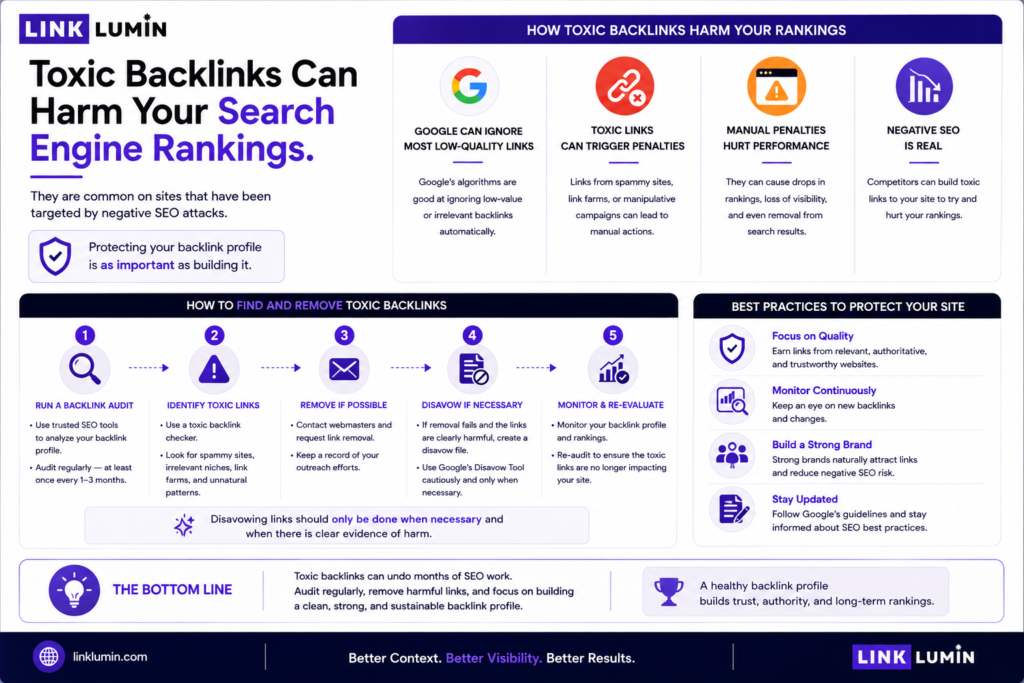
Toxic backlinks can harm your search engine rankings. They are common on sites that have been targeted by negative SEO attacks.
Google ignores most low-quality backlinks automatically. But toxic links — from spammy links, link farms, or manipulative link building campaigns — can trigger manual penalties.
Run a backlink audit regularly. Use a toxic backlink checker to identify harmful links. If disavowal is necessary, use Google’s Disavow Tool cautiously — disavowing links should only be done when necessary and when there is clear evidence of harm.
Protecting your backlink profile is as important as building it.
How Many Backlinks Do You Need?
There is no exact number. Referring domains matter more than link count.
A page with links from 50 authoritative, relevant referring domains will almost always outrank one with 500 links from low quality sites.
Focus on:
- Diversity of linking sites
- Relevance of referring domains to your niche
- Growth of inbound links over time — not a single burst
- Quality of anchor text — avoid over-optimised, exact-match patterns
Analyzing competitors’ backlinks reveals potential link opportunities you may have missed.
Backlinks and Internal Links Work Together
External links from other websites are only part of the picture. Internal links — linking from one page on your own site to another — distribute link equity across your site.
A strong internal link structure ensures that high-quality backlinks pointing to your homepage or top pages pass value to deeper pages too. Don’t neglect site links — they amplify the value of every inbound link you earn.
Common Mistakes to Avoid
- Buying paid links — violates Google’s guidelines and risks penalties.
- Link exchanges — reciprocal linking at scale is a red flag.
- Ignoring anchor text diversity — over-optimised anchor text looks unnatural.
- Letting broken links accumulate — broken backlinks waste link equity.
- Chasing link count over quality — a spammy backlink profile outweighs any benefit.
The Verdict
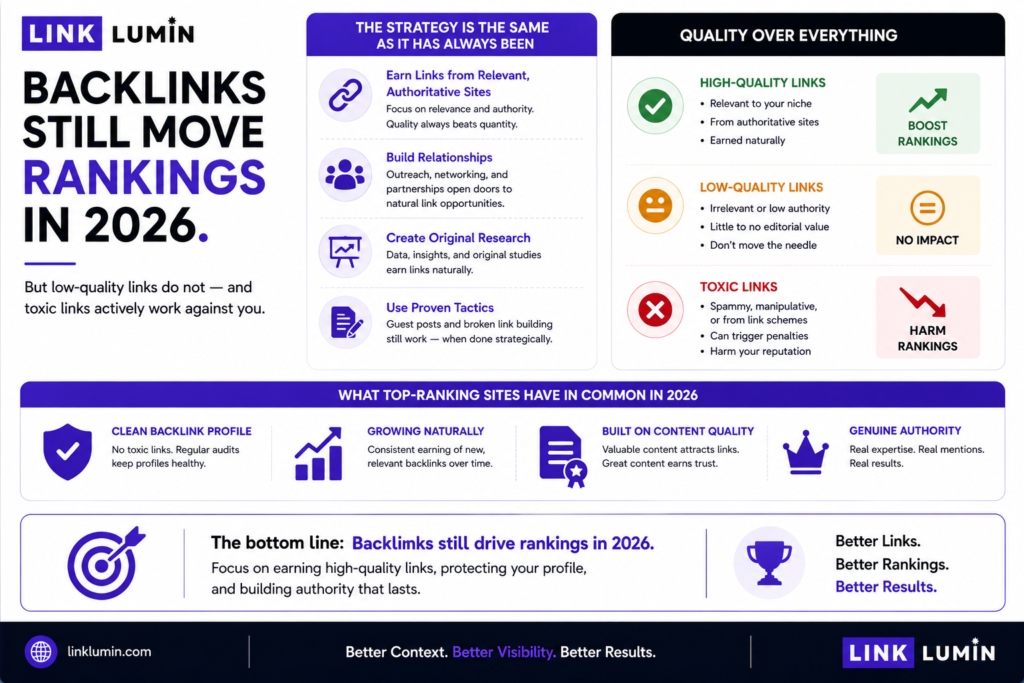
Backlinks still move rankings in 2026. But low-quality links do not — and toxic links actively work against you.
The strategy is the same as it has always been: earn links from relevant, authoritative sites by producing content worth linking to. Build relationships. Create original research. Use guest posts and broken link building tactically.
The sites that rank at the top of search engine results pages in 2026 have one thing in common: a clean, growing backlink profile built on content quality and genuine authority.
FAQs
1. Do backlinks still matter for SEO rankings in 2026?
Yes. High quality backlinks remain one of Google’s strongest ranking signals. Search engines treat backlinks as votes of confidence — relevant links from authoritative sites improve search rankings significantly. Low quality links carry little value and spammy backlinks can harm your rankings. A focused link building strategy targeting editorial backlinks and referring domains with genuine authority will continue to drive organic traffic.
2. What is the difference between dofollow and nofollow links?
Dofollow links pass link equity and improve search engine rankings — they are the default link type. The anchor text used signals topical relevance to search engines. Nofollow links carry a rel=”nofollow” attribute and do not pass ranking value, but they drive referral traffic and round out a natural link profile. User-generated content links, blog comments, and social media links are typically nofollow, meaning they pass no anchor text equity to the linked page.
3. How do toxic backlinks affect my site’s search rankings?
Toxic backlinks — from spammy sites, link farms, or manipulative link-building campaigns — can trigger manual penalties from Google. Search engines ignore many low-quality links automatically, but a concentrated pattern of unnatural links damages your rankings. Run a backlink audit regularly using a toxic backlink checker. Disavow harmful links only when there is clear evidence of a penalty — overly aggressive disavowal can remove links that are actually helping you.
4. What are the best link building tactics for earning high-quality backlinks?
The most reliable tactics are guest posts on relevant sites, broken link building, creating resource pages, and publishing original research that earns editorial backlinks naturally. Digital PR and relationship building produce authoritative media links over time. Content marketing can also attract backlinks organically when the content genuinely answers questions or fills gaps that other websites want to reference for their own readers.
5. How many backlinks does a page actually need to rank?
There is no fixed number. Referring domain quality and relevance matter far more than link count. One high-quality backlink from an authoritative site in your niche can outperform hundreds of low-quality links. Analyze your competitors’ backlink profiles to benchmark what is realistic for your target search rankings. Focus on consistent, steady growth in referring domains — not a single burst of incoming links that looks unnatural to search engines.