





Key Takeaways
- Content refresh wins for speed — updated pages can see significant traffic lifts faster than new content.
- New content wins for growth — it expands topical authority and targets new audiences.
- The strongest content marketing strategy uses both, guided by a content audit.
- Content refresh updates existing articles, statistics, and links for continued relevance.
- Content marketing generates approximately 3 times more leads than traditional outbound marketing (Demand Metric/CMI research; a widely cited industry benchmark).
- A content calendar keeps both approaches consistent and measurable.
Introduction
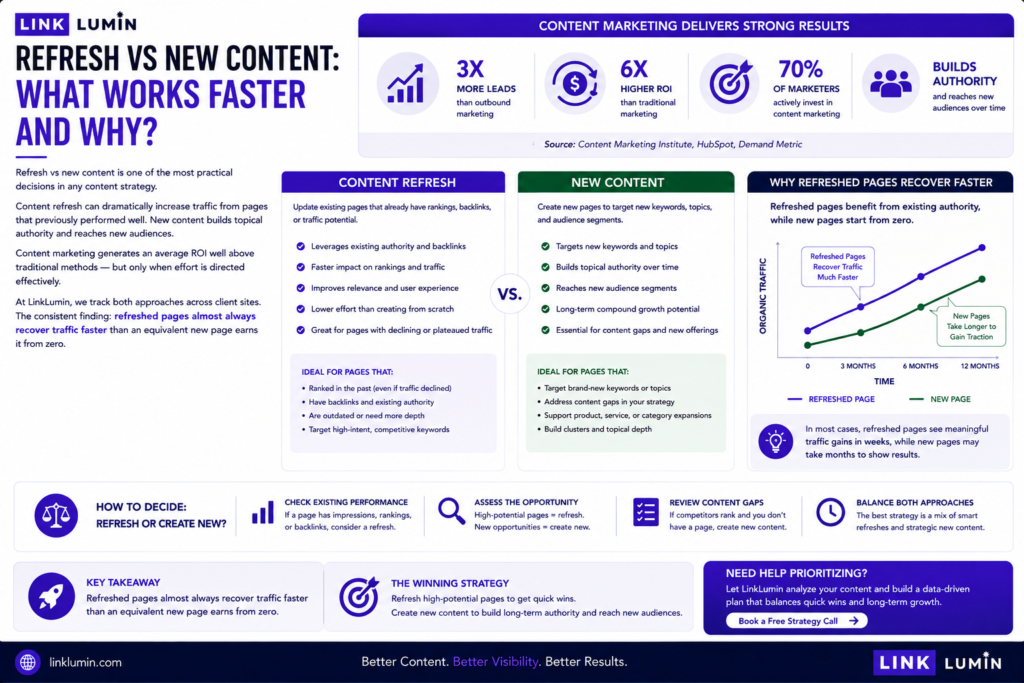
Refresh vs new content is one of the most practical decisions in any content strategy. Content refresh can dramatically increase traffic from pages that previously performed well. New content builds topical authority and reaches new audiences. Content marketing generates an average ROI well above traditional methods — but only when effort is directed effectively. At LinkLumin, we track both approaches across client sites. The consistent finding: refreshed pages almost always recover traffic faster than an equivalent new page earns it from zero.
Who This Guide Is For
This is for marketers and business owners who want more organic traffic without wasting content marketing budgets — whether you publish blog posts or manage a multi-channel content calendar.
The Case for Content Refresh
A content refresh involves updating existing content — adding new data, improving structure, fixing broken links, and realigning with current search intent. It is not a full rewrite.
The business case is compelling. Prioritise refreshing content that previously performed well. That content already has backlinks and authority. Updating it is cost effective compared to building new pages from zero.
Key refresh activities:
- Replacing outdated statistics with current data.
- Expanding thin sections with in-depth coverage.
- Adding relevant visual content or audio content.
- Improving the call-to-action and conversion rates focus.
Refreshed evergreen content is the most cost-effective way to sustain organic traffic long-term.
The Case for New Content
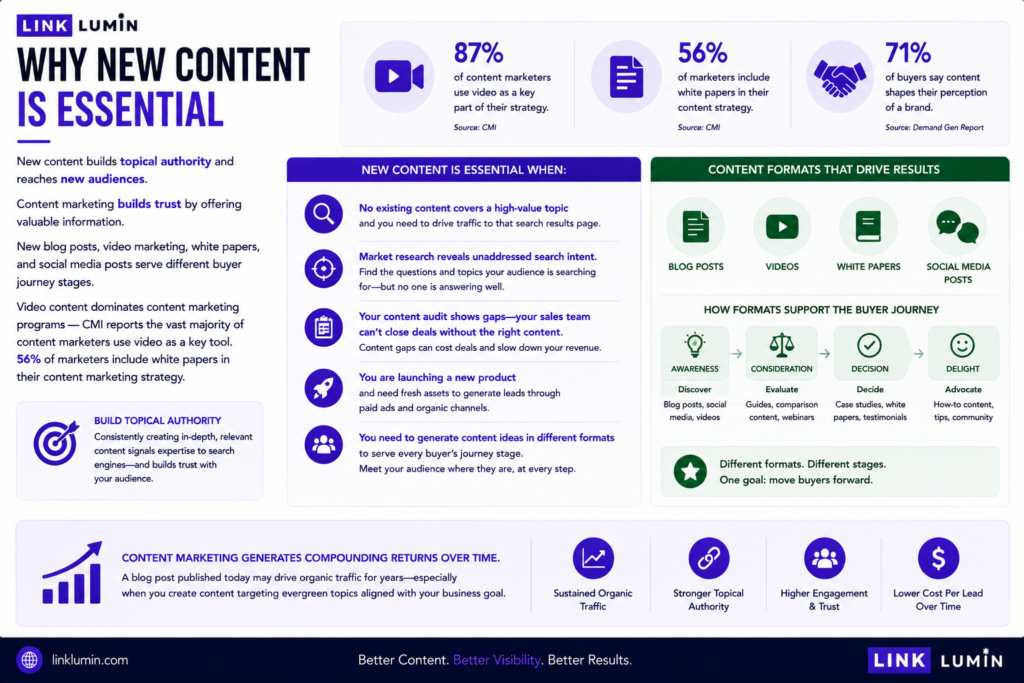
New content builds topical authority and reaches new audiences.
Content marketing builds trust by offering valuable information. New blog posts, video marketing, white papers, and social media posts serve different buyer journey stages. Video content dominates content marketing programs — CMI reports the vast majority of content marketers use video as a key tool. 56% of marketers include white papers in their content marketing strategy.
New content is essential when:
- No existing content covers a high-value topic and you need to drive traffic to that search results page.
- Market research reveals unaddressed search intent.
- Your content audit shows gaps — your sales team can’t close deals without the right content.
- You are launching a new product and need fresh assets to generate leads through paid ads and organic channels.
- You need to generate content ideas in different formats to serve every buyer’s journey stage.
Content marketing generates compounding returns over time. A blog post published today may drive organic traffic for years — especially when you create content targeting evergreen topics aligned with your business goals.
What a Content Audit Reveals
Before choosing between refresh and new, run a content audit. A content audit evaluates existing content to identify what works and what needs updating. Categorise every piece into three buckets:
- Keep and promote — high performing content driving organic traffic and leads.
- Refresh — content with traffic potential that has declined or stagnated.
- Create new — topic gaps identified through keyword research and market research.
Use Google Analytics to identify which existing content drives traffic and which has flatlined. Track organic sessions, time on page, bounce rate, and conversion rates. This makes your content marketing strategy data-driven.
Choosing the Right Approach: A Decision Framework
| Signal | Refresh | Create new |
|---|---|---|
| Page previously ranked, traffic declined | ✅ | |
| Topic is evergreen, content is outdated | ✅ | |
| Limited budget or team capacity | ✅ | |
| No existing page on the topic | ✅ | |
| Buyer persona or market has shifted significantly | ✅ | |
| Content audit reveals a clear topic gap | ✅ | |
| Both declining pages and topic gaps exist | ✅ | ✅ |
Content marketing costs significantly less per lead than traditional marketing methods — industry research consistently cites approximately 62% lower cost-per-lead (Demand Metric/CMI benchmark). A mix of refresh and creation maximises that efficiency.
Building the Content Strategy That Wins
The real winner is a coherent content strategy that connects both.
A content strategy should align content creation with business objectives, define buyer personas, and assign content ideas to each stage of the marketing funnel. SMART criteria define clear and measurable objectives.
A successful content marketing strategy includes:
- A content calendar — scheduling topics consistently across social media platforms, email marketing, and blog posts.
- An editorial calendar — managing content marketing efforts through brand guidelines that reinforce brand identity.
- Clear distribution — knowing which channels carry each content format for maximum social media engagement.
- Clear metrics — tracking key performance indicators through Google Analytics against business goals.
- Thought leadership — building a loyal audience through high-quality content that demonstrates genuine expertise.
Content strategies create consistency in messaging and allocate resources to serve potential customers at every funnel stage.
How to Execute a Refresh Strategy
Refreshing content is a skill. Done well, it compounds results. Done poorly, it wastes time.
Prioritise pages with:
- Existing backlinks and domain authority.
- Declining traffic despite solid historical performance.
- Topics that remain relevant to your buyer persona.
The refresh process:
- Audit to identify which content performed well historically.
- Check current search intent for target keywords.
- Update statistics, add new content formats, and expand thin sections.
- Repurpose content into social media content or podcast-friendly audio summaries.
- Incorporate user-generated content and storytelling techniques for authenticity.
- Update the publish date and resubmit to Google Search Console.
- Promote through social media posts and email marketing as if it were new.
Keep your team on the same page about refresh value — pointing your content marketing in the right direction often starts here. Refreshed content with high social media engagement can outperform brand-new posts published the same week.
The Verdict
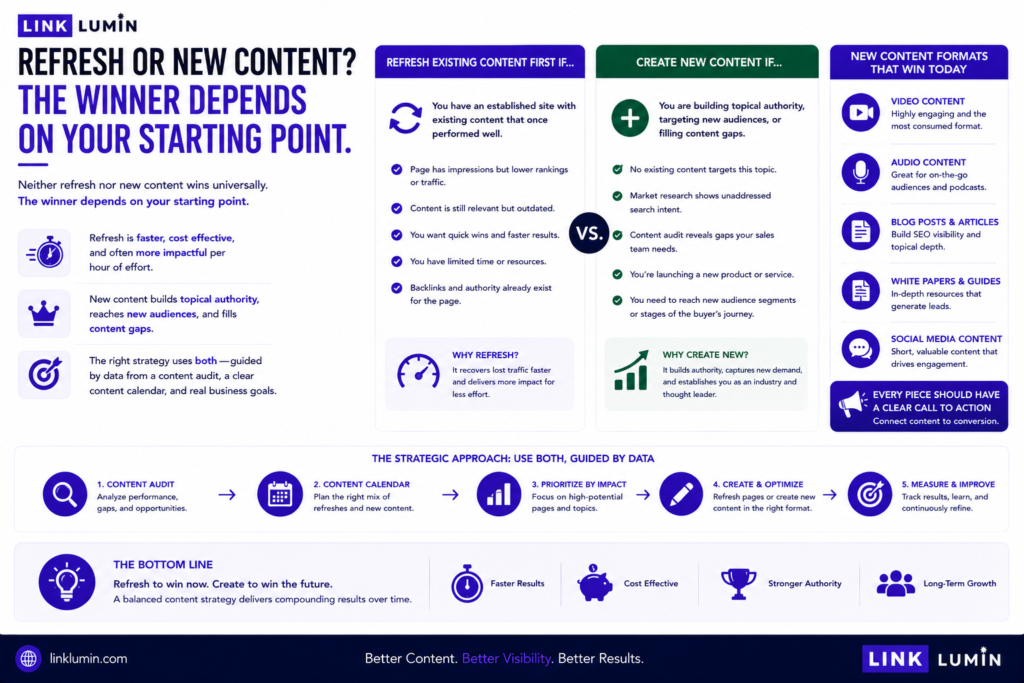
Neither refresh nor new content wins universally. The winner depends on your starting point.
If you have an established site with existing content that once performed well — refresh first. It is faster, cost effective, and often more impactful per hour of effort.
If you are building topical authority, targeting new audiences, or filling content gaps — create new content in different formats. That is how you become an industry leader and thought leader. Video marketing and audio content are increasingly popular for audiences who don’t read long articles. A clear call to action in every piece ties content to conversion.
The good content strategy uses both — guided by data from a content audit, a clear content calendar, and real business goals.
FAQs
1. What is a content refresh versus publishing new content?
A content refresh updates existing articles — replacing outdated data, improving structure, and realigning with search intent. It is distinct from the content creation process of building new pages from scratch. Refresh is cost effective, especially for evergreen content with existing authority. New content is essential for filling gaps identified in a content audit or reaching new stages of the content marketing funnel.
2. How do I decide which approach fits my business goals?
Start with a content audit. Evaluate which existing content drives organic traffic, which has declined, and which topics lack coverage. If valuable content has lost traffic — refresh it. If your content marketing funnel has gaps your target audience needs answered — create new content. Most businesses need both. Align decisions to your content calendar, budget, and buyer persona research to move in the right direction.
3. How does a content audit fit into a content marketing strategy?
A content audit is the foundation of a content marketing strategy. It evaluates every piece of existing content against key performance indicators — organic traffic, conversion rates, time on page — to identify what to keep, refresh, or replace. Without one, your content creation process is guesswork. With one, you allocate resources effectively and build a strategy that serves real business goals.
4. What content formats work best for driving organic traffic?
Blog posts, video content, white papers, and infographics consistently drive organic traffic across buyer journey stages. Video marketing is used by the vast majority of content marketers. The right content formats depend on your buyer persona and where they sit in the content marketing funnel. A content calendar helps schedule a mix of formats consistently across different formats and channels.
5. How often should I refresh versus publish new content?
There is no universal rule — it depends on content volume, team size, and business goals. A common approach: audit your top 20–30 pages quarterly, refresh those with declining traffic, and maintain a steady cadence of new content ideas and new content creation. Your content calendar makes this visible and keeps the content marketing funnel aligned. Many brands refresh two or three pieces for every new piece they create.