



Service area pages are dedicated location pages that help service-based businesses rank in local search results across the neighbourhoods they serve — without a physical storefront in each location. For Toronto businesses covering areas from North York to Scarborough, building these pages correctly determines whether your business appears in Google Search for local customers or gets filtered out as thin, duplicate content. This guide covers what makes a Toronto service area page work, the most common mistake that gets these pages penalized, and how to build pages that earn genuine local search visibility across Toronto’s distinct neighbourhoods.
Key Takeaways
- Service area pages help service-based businesses rank across Toronto neighbourhoods without a physical address in each location.
- The most common mistake is building “find-and-replace” doorway pages — identical templates where only the neighbourhood name changes. Google treats these as thin, duplicate content.
- Each service area page needs genuinely distinct local content: neighbourhood-specific property details, local landmarks with operational relevance, and real proof of work in that area.
- Generic tourist landmarks signal to search engines that the content was not written by someone with local expertise.
- Internal links between service area pages and the main services pages strengthen the authority of the entire section.
- Google Business Profile allows service area businesses to specify their service areas and hide their physical address — this works alongside dedicated service area pages, not instead of them.
- Structured data (LocalBusiness schema) helps Google understand the geographic focus of each page.
What Are Service Area Pages and Why Do They Matter for Local Search?
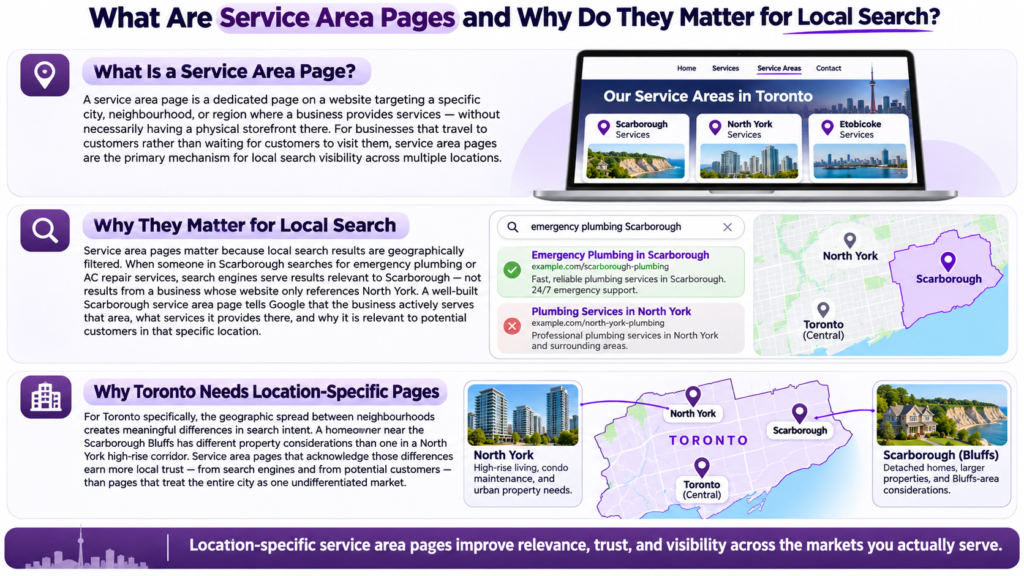
A service area page is a dedicated page on a website targeting a specific city, neighbourhood, or region where a business provides services — without necessarily having a physical storefront there. For businesses that travel to customers rather than waiting for customers to visit them, service area pages are the primary mechanism for local search visibility across multiple locations.
Service area pages matter because local search results are geographically filtered. When someone in Scarborough searches for emergency plumbing or AC repair services, Google serves results relevant to Scarborough — not results from a business whose website only references North York. A well-built Scarborough service area page tells Google that the business actively serves that area, what services it provides there, and why it is relevant to potential customers in that specific location.
For Toronto specifically, the geographic spread between neighbourhoods creates meaningful differences in search intent. A homeowner near the Scarborough Bluffs has different property considerations than one in a North York high-rise corridor. Service area pages that acknowledge those differences earn more local trust — from search engines and from potential customers — than pages that treat the entire city as one undifferentiated market.
Service Area Businesses vs. Brick-and-Mortar Businesses
The distinction between service area businesses and brick-and-mortar businesses shapes how local SEO works for each. Brick-and-mortar businesses — law offices, retail stores, clinics — have a physical address that customers visit. Their location pages highlight store hours, directions, and location-specific details tied to that physical storefront.
Service area businesses — plumbing, HVAC, mobile pet grooming — travel to customers rather than receiving them at a fixed location. Their service area pages focus on the neighbourhoods served and local context that demonstrates they regularly work in that community. Google Business Profile allows service area businesses to define their service area and hide their physical address.
The Find-and-Replace Problem: Toronto’s Most Common Mistake
The single biggest mistake when building service area pages across Toronto is mass-producing identical templates where only the neighbourhood name is swapped. A page titled “Plumber in North York” becomes “Plumber in Scarborough” with the surrounding paragraphs left completely unchanged — services listed, descriptions, calls to action all identical. Only the keyword in the title and a few heading mentions change.
Search engines treat these as doorway pages or thin, duplicate content. When pages offer no unique local value beyond a swapped keyword, Google often declines to index them, drops their rankings due to keyword cannibalization between competing pages on the same site, or flags them under spam policies for scaled content abuse. The result is a website with dozens of area pages that drive no local search traffic because Google has either ignored them or consolidated them into a single result.
This mistake is common in competitive Toronto markets where agencies build large sets of location pages quickly. The logic seems sound: more pages should mean more coverage. It does not — duplicate pages compete with each other for the same query, diluting the ranking authority of all of them.
What Makes a Toronto Service Area Page Genuinely Distinct
Hyper-Local Signals That Work
The local signals that move the needle for Toronto service area pages are granular neighbourhood names, hyper-local property details, and real proof of work — not generic city landmarks. Mentioning the CN Tower on a Scarborough roofing page signals that the content was written by someone unfamiliar with that community. Mentioning the wind exposure near the Scarborough Bluffs, the effect of seasonal freeze-thaw cycles on older Scarborough housing stock, or the density of post-war bungalows in specific Scarborough pockets signals genuine local knowledge.
For North York, the mix of mid-century apartment corridors along Yonge Street and sprawling post-war subdivisions further north creates real service differences. A window company, an HVAC business, or a cleaning service operates differently in a high-rise building than in a detached home on a large lot. A service area page that acknowledges those operational differences is not just better SEO — it is more useful to the customer reading it.
Useful hyper-local signals for Toronto service area pages include:
- Neighbourhood-specific housing types and age ranges (post-war bungalows, 1960s high-rises, newer Scarborough waterfront builds)
- Local infrastructure details that affect service delivery (transit access for on-site services, parking considerations in denser areas)
- City-specific challenges: older pipe materials in established North York neighbourhoods, or zoning patterns in East York that affect permitted work
- Local landmarks with operational relevance, not tourist relevance
Proof of Work Over Generic Descriptions
Proof of work — photos of completed projects in the specific neighbourhood, local customer reviews that name the area, project descriptions referencing recognizable local streets or building types — builds credibility that generic descriptions cannot. A Scarborough plumbing page that includes a review mentioning a specific street in West Hill carries more trust signal than one that simply lists Scarborough as a service location.
Service descriptions tied to actual properties and conditions in an area reinforce to search engines that the business genuinely operates there. Community involvement — local sponsorships, neighbourhood associations, local events — adds further context that distinguishes a genuine operator from one that simply listed an area as a target.
Building Service Area Pages Across Toronto Neighbourhoods
Toronto’s current geography reflects the 1998 amalgamation that merged the former cities of Toronto, North York, Scarborough, Etobicoke, East York, and York into one municipality. The city now contains 158 distinct neighbourhoods, each with its own housing stock, infrastructure age, and community character. That scale is what makes service area page strategy necessary — and what makes find-and-replace pages so ineffective.
North York Service Area Pages
North York’s diversity reflects its size. The commercial corridors along Yonge, the dense residential development near Sheppard-Yonge, and the quieter residential pockets of Willowdale and Newtonbrook each present different service conditions. A service area page targeting North York should identify which specific neighbourhoods within North York the business serves and reflect the housing and infrastructure realities of those sub-areas.
A plumbing or HVAC business serving North York’s high-rise corridors deals with property managers, condo corporations rather than individual homeowners — that operational reality belongs on the page. A cleaning service operating in North York’s detached home neighbourhoods works in entirely different conditions. The closer a service area page gets to those operational specifics, the more it distinguishes itself from a generic template.
Scarborough Service Area Pages
Scarborough’s east-west span and its range of housing stock — from waterfront properties near the Bluffs to post-war residential areas in Agincourt and L’Amoreaux — make it a service area that rewards specific targeting. A single “Scarborough” page competes with every other Scarborough page. A page targeting Agincourt specifically, or addressing the housing age and style in Cliffside, narrows the audience and increases relevance for the searcher who lives there.
Environmental specifics matter in Scarborough: properties near the Bluffs face different weathering conditions than those in inland Scarborough. A roofing, siding, or exterior maintenance business that acknowledges wind exposure, moisture from the lake, and the effect on roofing materials over time signals local expertise that a generic Scarborough page cannot.
Etobicoke, East York, and York
The same logic applies across Etobicoke, East York, and York — the sixth former city that amalgamation often leaves out of Toronto coverage. Etobicoke’s mix of older lakeside communities, newer development near the airport corridor, and established family neighbourhoods each carry distinct service implications. East York’s density of semi-detached homes creates a different context than more recent suburban development. York — the former municipality between North York and the downtown core — has its own housing age and character that separates it from both. Each area rewards a separate service page built around its own local details.
Technical SEO for Toronto Service Area Pages
Internal Links and Site Architecture
Internal links connect service area pages to each other and to the main service pages they support, distributing authority across the site and helping search engines understand the relationship between pages. Each neighbourhood page should link back to the relevant main service page — emergency plumbing, AC repair services, or whichever core service applies — and to a central service area hub page for the broader Toronto market.
A service area hub page — a central Toronto page linking out to each individual neighbourhood page — creates a clear hierarchy that search engines can follow. This architecture signals that the service area pages are part of a deliberate geographic structure, not standalone pages with no relationship to the rest of the site.
Duplicate Content and Site Structure
Avoiding duplicate content means writing each page from scratch with location-specific detail, not adapting a template. Where some structural elements repeat across pages — service descriptions, the core business offer — the surrounding content must be distinct enough that each page serves a different search intent and audience.
The goal is pages distinct enough that no two compete for the same search query. Each page should target its own specific area with content written for that area — not a variation of another page on the same site.
Structured Data and Local Business Schema
Local business schema markup communicates the geographic focus of a service area page to search engines in a structured format. For service area businesses, schema can specify the areas served, the services offered, and business contact details in a format Google can read without interpretation. Schema reinforces what well-written local content already provides.
Google Business Profile and Service Area Pages
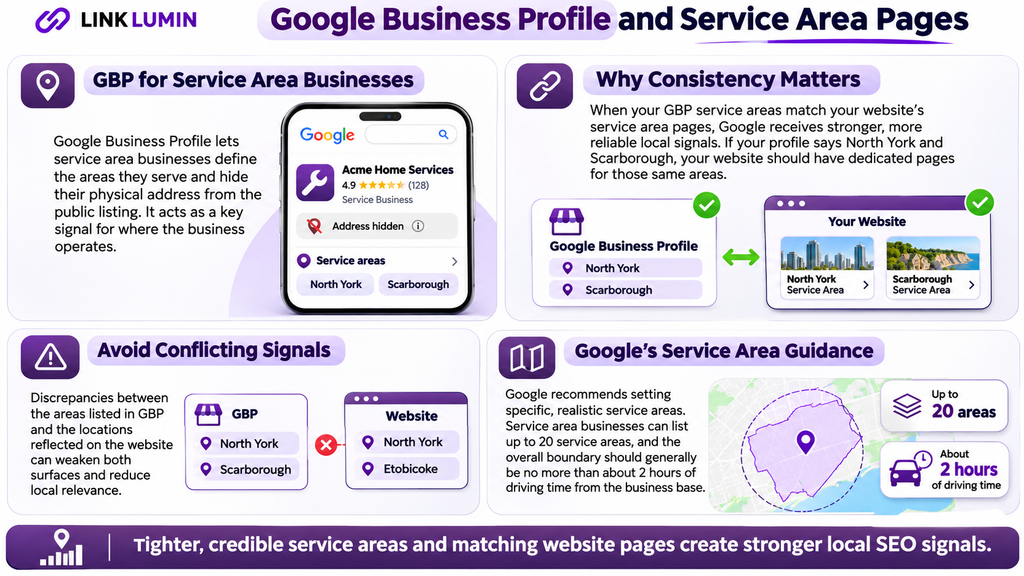
Google Business Profile allows service area businesses to specify areas served and hide their physical address from the public listing. The GBP is a primary reference for where a business operates — one that lists North York and Scarborough as service areas, combined with dedicated website pages for each, creates consistent signals across both surfaces.
Keeping the GBP service area list consistent with the website’s service area pages maintains reliable local rankings. Discrepancies between what the GBP says a business serves and what the website pages reflect create conflicting signals that weaken both surfaces.
Google recommends defining service areas that can realistically be covered in about two hours of travel, and limits service area businesses to approximately 20 service areas. Setting areas beyond that range produces weaker local signals than a tighter, more credible coverage map.
Frequently Asked Questions
What are service area pages and why do they matter for local search?
Service area pages are dedicated website pages targeting specific cities or neighbourhoods where a business provides services without a physical storefront in each location. They matter for local search because Google filters results geographically — a page targeting Scarborough specifically helps a business appear in Scarborough search results rather than being outcompeted by businesses with a local address there.
How do I avoid duplicate content across Toronto service area pages?
Avoiding duplicate content means writing each page with genuinely location-specific information — neighbourhood housing types, local landmarks with operational relevance, real proof of work in that area — rather than swapping only the neighbourhood name in an otherwise identical template. Pages with no unique local value are treated as doorway pages and either ignored or penalized.
How should internal links connect service area pages?
Internal links should connect each neighbourhood service area page to the relevant main service page and to a central Toronto hub page. This hierarchy distributes authority across the site and helps Google understand the geographic structure of the section.
Should home service businesses use Google Business Profile alongside service area pages?
Yes. Google Business Profile and service area pages work together. The GBP specifies which areas a service area business serves and can hide the physical address for businesses that do not receive customers at their location. Service area pages on the website provide the content depth — local signals, proof of work, specific services — that GBP listings alone cannot carry.
How do local landmarks help service area pages rank in Google Search?
Local landmarks help service area pages rank when they carry operational relevance to the service being offered — not when they are generic tourist references. A roofing page referencing weather exposure near the Scarborough Bluffs demonstrates local knowledge. A plumbing page that mentions the CN Tower does not. Search engines and customers both recognize the difference between content written by someone who works in an area and content that only names it.
What is the difference between a service area page and a location page for local businesses?
A location page represents a physical storefront where customers visit — it highlights address, hours, directions, and details tied to that physical presence. A service area page targets a region the business serves by travelling to customers, with no physical storefront there. Both require distinct, locally relevant content, but they serve different business models and address different search intents.
Build Service Area Pages That Rank Across Toronto
Link Lumin builds service area pages for Toronto businesses as part of a full Toronto SEO strategy — locally specific content, structured internal linking, and the technical setup that gets pages indexed and ranked rather than filtered as duplicate content.
Contact Link Lumin to discuss your service area page strategy — or call (647) 699-2555. You can also reach the team at contact@linklumin.com.
61 Alness St Unit 226, North York, ON M3J 2H2